STEAM EmPOWERment showcases the work of several schools in the Paterson Public Schools including: Charles J. Riley School 9, School 12, Joseph A. Taub School. In partnership with William Paterson University, and funded by the Geraldine R. Dodge Foundation, the program integrates art into other core areas, increasing student achievement, engagement, and creativity.
This year has been an exciting first year for our blog. We have showcased the activities that are going on in those Paterson Public Schools in which we have implemented the William Paterson University STEAM grant. This grant, which has been funded by the Geraldine R. Dodge Foundation, demonstrates that the integration of visual art with science, technology, and math increases student achievement. Above all, the work of the students, teachers, and professors in residence emphasizes the most important aspect of student learning, which is CREATIVITY.
We are happy to be able to report that funding has been renewed for the next school year, and that we will be continuing our efforts in 2014-2015. We will be planning new activities over the summer months.
We are putting our blog to sleep for the next two months, and will resume posting in September. Meanwhile, we leave with a few pictures that encapsulate the very essence of STEAM: some student portraits that evolved from their 3D printing experience, a three-part activity that took place on May 13th, May 19th, and May 27th.
The William Paterson University Paterson High School STEAM grant program has been featured on the Geraldine R. Dodge.org website under "Featured News"
"(June 3, 2014) Students at Eastside High School in Paterson recently
worked with William Paterson University as part of a partnership to
promote the traditional elements of STEM — science, technology,
engineering and math — with the addition of art — STEAM. Read the Bergen Record story and view a photo gallery from the day here.
From the article by Minjae Park, Staff Writer, the STEAM prpgram—
"is the product of a partnership between the Paterson school district and William Paterson University that aims to promote the traditional elements of STEM – science, technology, engineering and math – with the addition of art: STEAM. In the past two years, Schools 2 and 7 and Eastside High School have adopted science-and-art classes designed by their teachers and by William Paterson professors who spend a few days each week working at the schools".....
....."The partnership between the university and the Paterson school district is funded through a grant from the Geraldine R. Dodge Foundation, based in Morristown. In April the foundation approved $130,000 for the university to continue and expand its STEAM program next year, adding to the $200,000 from the previous two years."
For the complete article see this LINK William Paterson University is featuring photos from the STEAM program at its Facebook page at http://on.fb.me/1lXOixB
Above: Artworks created in GOPA Art Teacher Darryl Jones' class suing pastels and grids
he
class — part art, part math — is the product of a partnership between
the Paterson school district and William Paterson University that aims
to promote the traditional elements of STEM – science, technology,
engineering and math – with the addition of art: STEAM.
In the past two years, Schools 2 and 7 and Eastside High School
have adopted science-and-art classes designed by their teachers and by
William Paterson professors who spend a few days each week working at
the schools.
- See more at: http://www.northjersey.com/news/education/learning-art-for-math-s-sake-1.1027902?page=1#sthash.srh7cqKM.dpuf
is
the product of a partnership between the Paterson school district and
William Paterson University that aims to promote the traditional
elements of STEM – science, technology, engineering and math – with the
addition of art: STEAM.
In the past two years, Schools 2 and 7 and Eastside High School
have adopted science-and-art classes designed by their teachers and by
William Paterson professors who spend a few days each week working at
the schools.
- See more at: http://www.northjersey.com/news/education/learning-art-for-math-s-sake-1.1027902?page=1#sthash.srh7cqKM.dpuf
is
the product of a partnership between the Paterson school district and
William Paterson University that aims to promote the traditional
elements of STEM – science, technology, engineering and math – with the
addition of art: STEAM.
In the past two years, Schools 2 and 7 and Eastside High School
have adopted science-and-art classes designed by their teachers and by
William Paterson professors who spend a few days each week working at
the schools.
- See more at: http://www.northjersey.com/news/education/learning-art-for-math-s-sake-1.1027902?page=1#sthash.srh7cqKM.dpuf
In a college-high school cooperation, science and tech meets art
It was a geometry lesson on ratios, but there was Tevaughn Grant,
his fingers smeared in pink from rubbing soft chalk pastels onto his
drawing of a rose.
"I drew up a grid, then I drew a picture, then I erased the lines
and I started the pastel," said the 11th-grader at Eastside High School
in Paterson, explaining a technique that employs math as well as art.
Beside him, Marque Champion, a 12th-grader, had taken an image of a
face and drawn a grid of 36 one-inch squares on it – nine across and
four down. On a larger canvas, he drew a similar grid, but with each
square measuring 2 inches. Then he copied the original, box by box, to
create a face that was quadruple the size.
"Instead of drawing what you see, it helps you focus on the
boxes," he said, showing how each box helped keep the drawing in
proportion.
The class — part art, part math — is the product of a partnership
between the Paterson school district and William Paterson University
that aims to promote the traditional elements of STEM – science,
technology, engineering and math – with the addition of art: STEAM.
In the past two years, Schools 2 and 7 and Eastside High School
have adopted science-and-art classes designed by their teachers and by
William Paterson professors who spend a few days each week working at
the schools.
"Creativity is key, and art tends to bring the creativity," said
Dina Scacchetti, a William Paterson science professor often at Eastside
High.
William Paterson art professor Triada Samaras, the other
professor-in-residence at Eastside High, said art teaches students
something other subjects don't.
"We say, 'Take risks and fail,' " she said. "Failure is expected
in art and even encouraged, because through failures you eventually
succeed, and this kind of thinking is very useful" for science- and
math-oriented studies.
At Eastside High's School of Government and Public Administration,
students in the science-oriented art classes also have calculated the
volume of ceramic sculptures they craft, then measured how much water
the sculptures actually hold; and they had their faces scanned at
William Paterson to make three-dimensional Styrofoam cutouts, an
experience that allowed them to experiment with complex software.
The infusion of art into math and science has seen some positive
early signs in Paterson, Scacchetti said, with bilingual second-grade
students who had studied in the curriculum outperforming their
monolingual peers in math scores.
By boosting core subjects, art — often seen as more expendable
than the subjects for which students are tested — is placed on a firmer
footing in schools.
"It makes a powerful argument for the case that art doesn't take
away from time in science and math," said Candace Burns, dean of William
Paterson's College of Education.
The partnership between the university and the Paterson school
district is funded through a grant from the Geraldine R. Dodge
Foundation, based in Morristown. In April the foundation approved
$130,000 for the university to continue and expand its STEAM program
next year, adding to the $200,000 from the previous two years.
In addition to allowing professors-in-residence, the grant helps
buy supplies and funds field trips to museums, said Scacchetti, the
university's coordinator for the grant.
In a class at Eastside High's School of Information Technology,
Marilyn Simon, an art teacher, demonstrated tessellation, in which
copies of a shape are fitted together like a mosaic to cover a plane,
with no overlaps or gaps.
"It was a regular square first, and then we cut it and we put it
on the bottom," said Angeline Francois, an 11th-grader, as she finished
drawing a sequence of sharp edges and winding curves. "And me, being
complicated — I made this."
On their shapes, students transposed paintings of fish, butterflies, ducks — whatever the patterns could conceivably depict.
"Your job is to find something in this," Simon told students. "Keep turning it to see if you see something in it."
She compared the process to divining shapes from clouds.
Francois, a Picasso fan, said she mainly enjoyed the art but didn't mind the small math lesson.
The 5th Annual New Jersey Professional Development Schools Conference was held at William Paterson University on May 20, and focused upon the theme "Successful Strategies for PDS." Over 200 people attended this event, including K-12 teachers and administrators, as well as college faculty members. WPU's College of Education representation was led by Dean Candace Burns, Associate Dean Dorothy Feola, and Director of Professional Development and School/Community Partnerships Nancy Norris-Bauer.
The keynote speaker Marcia Tate, Consultant, Author & Co-Founder of Developing Minds Inc., presented twenty brain compatible strategies to increase student achievement from her book, Worksheets Don’t Grow Dendrites: 20 Instructional Strategies that
Engage the Brain (Second Edition). These strategies are regularly employed in the arts. For example, the power of "visuals" is well known in every art classroom. Tate thus made an excellent case for STEAM, as well as for arts integration. Break out sessions followed the keynote, and three of these sessions were presented by Art Professors in Residence and teachers from four schools in Paterson, NJ. These schools (School 2, School 7, the School of Government,and the School of Information Technology) have all been awarded a generous Geraldine R. Dodge Grant to develop and implement STEAM curricula.
Simone Sandler, Art PIR at Paterson School 2, and Second Grade Teacher Belinda Casais-McBride presented, "Steam EmPOWERment: Strategies for an Elementary School." Their presentation stressed hands-on activities. Examples included those in which students engaged in "engineering projects," such as bridge-building.
Above: WPU Art PIR Simone Sandler and Second Grade Teacher Belinda Casais-McBride present "STEAM EmPOWERment: Strategies for an Elementary School"
Myra Winter, Art PIR at Paterson School 7, Art Teacher Vernon Nealy, Fifth Grade Math Teacher Melissa Bensh, and Principal Nicholas Vancheri presented "STEAM EmPOWERment: Strategies for a Middle School." Principal Vancheri offered insight into how STEAM strategies have positively impacted the entire learning environment of the school.
Above: School 7 Principal Nicholas Vancheri presents STEAM EmPOWERment: Strategies for a Middle School Lastly Art PIR Triada Samaras, School of Government Art Teacher Darryl Jones, and School of Information Technology Art Teacher Marilyn Simon presented: "STEAM EmPOWERment Strategies for a High School," which stressed the transdisciplinary nature of STEAM. Both high school principals, Dr. Karen Johnson and Ms. Vivian Gaines, attended this sessions.
Above: WPU Art PIR Triada Samaras presents STEAM EmPOWERment: Strategies for a High School
Above: Geraldine R. Dodge Manager, Dina Scacchetti, and GOPA Art Teacher Darryl Jones
present STEAM EmPOWERment: Strategies for a High School
Above: SOIT Art Teacher Marilyn Simon talks to Paterson Principal on Assignment for Fine and Performing Arts, Cora Quince
Above: Tyler Zeleny, Michael Rees, Geoff Flash, and Brian Sandilands visit GOPA/SOIT
On Tuesday May 27, Professor Michael Rees and his current and former graduate students: Brian Sandilands, Tyler Zeleny, and Geoff Flash came back to GOPA and SOIT to visit the STEAM students who went on the field trip to the WPU Power Arts Building last week LINK.
They
brought three D portraits of the students machine cut out of styrofoam
as well as a few printed with the three D printer in black and orange plastic, to GOPA Art
Teacher, Mr. Jones' STEAM class. (The remainder of the smaller
plastic portraits are still being fabricated at the Power Arts building
by the graduate students in the 3-D sculpture shop there.)
Also in attendance in the art classroom were SOIT art teacher, Marilyn Simon with her STEAM students, WPU Art Professor in Residence Triada Samaras, and WPU Math and Science PIR and Dodge Grant Manager, Dina Scacchetti. Later several members of the Paterson Alliance and school principals, Principal Vivian Gaines (SOIT) and Dr. Karen Johnson (GOPA).
Above: Michael Rees with Principal Vivian Gaines and mebers of the Paterson Alliance. Below right: Michael Rees with Principal Karen Johnson
Professor
Rees spoke to the students about the 3 D printing process first,
explaining that "failures" with the three D technology are always
opportunities to learn. "Failures," Rees explained, "in fact create
later successes." He also talked about the geometry inherent in the 3 D
printing process and explained how 3 D printers use hexagonal patterns
to create objects.
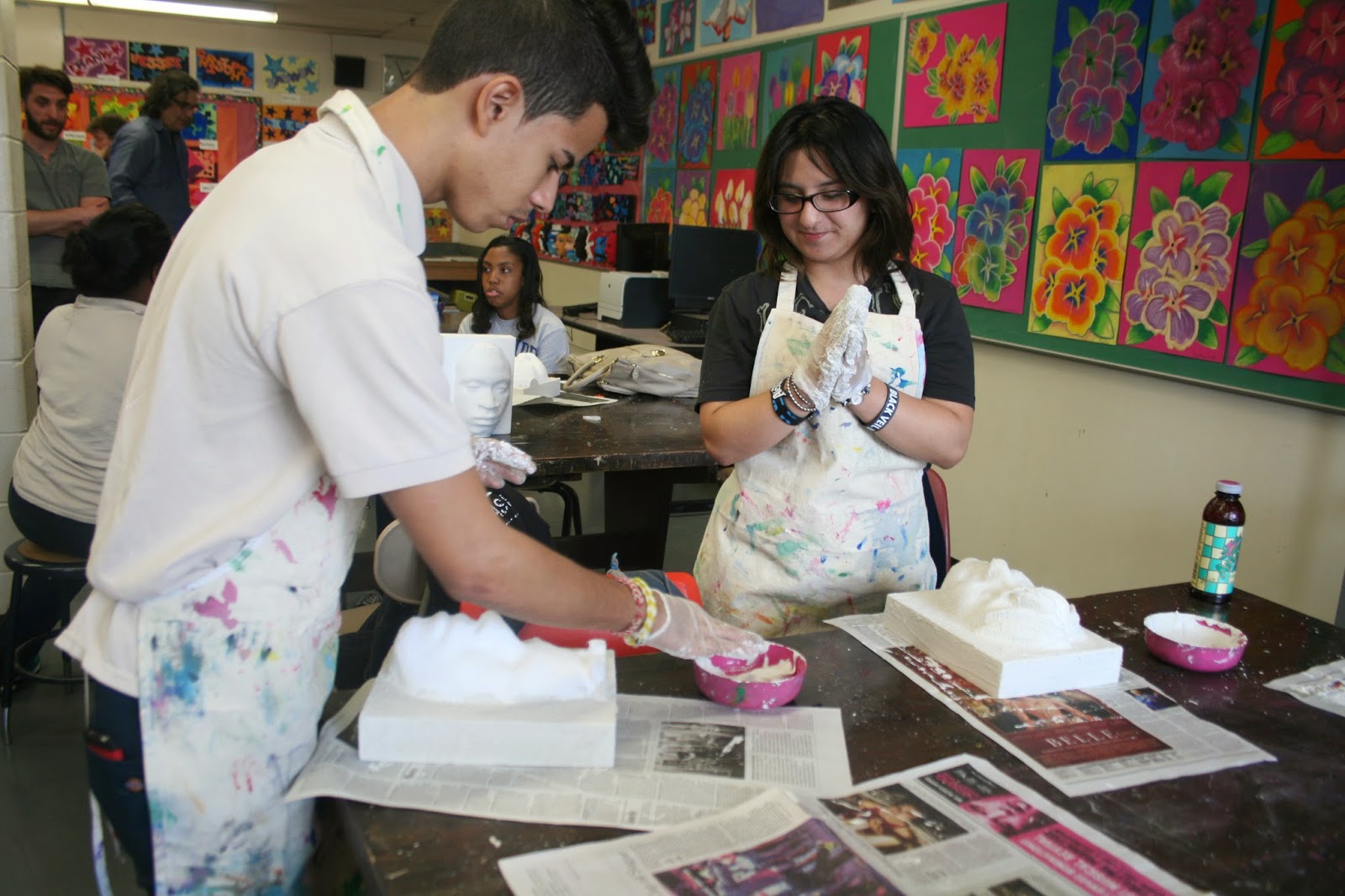
Next Professor Rees and his graduate students handed out works to the students. Each student received his/her own styrofoam self portrait. He then demonstrated working with both joint compound and with wood glue and newspaper to collage, and encouraged the students to begin working on the portraits with hands-on materials. Students discussed the differences between sculpture and painting and contemplated their options for changing the surface of their portraits.
Art Teachers Mr. Jones and Mrs. Simon will have the the STEAM students continue working on these art projects in the days to come.
Above: SOIT Art Teacher Marilyn Simon reflects on a student portrait
Above: GOPA and SOIT STEAM students observe the 3 D printers with Dina Scacchetti
On Monday May 19, GOPA and SOIT the STEAM students who attended Professor Rees's presentation last week at Eastside High School LINK took a field trip to the Power Arts Building. Also in attendance were Art Teachers, Marilyn Simon and Darryl Jones, WPU ART PIR Triada Samaras and Math and Science PIR Dina Scacchetti.
Above: Triada Samaras, Dina Scacchetti, and Marilyn Simon
At the WPU Power Arts Building, the students were met by Professor Rees and two current WPU graduate art students, Brian Sandilands and Tyler Zeleny, as well as former graduate art student Geoff Flash who is also a New Jersey Public High School Art Teacher.
Above: Geoff Flash, Marilyn Simon and Darryl Jones
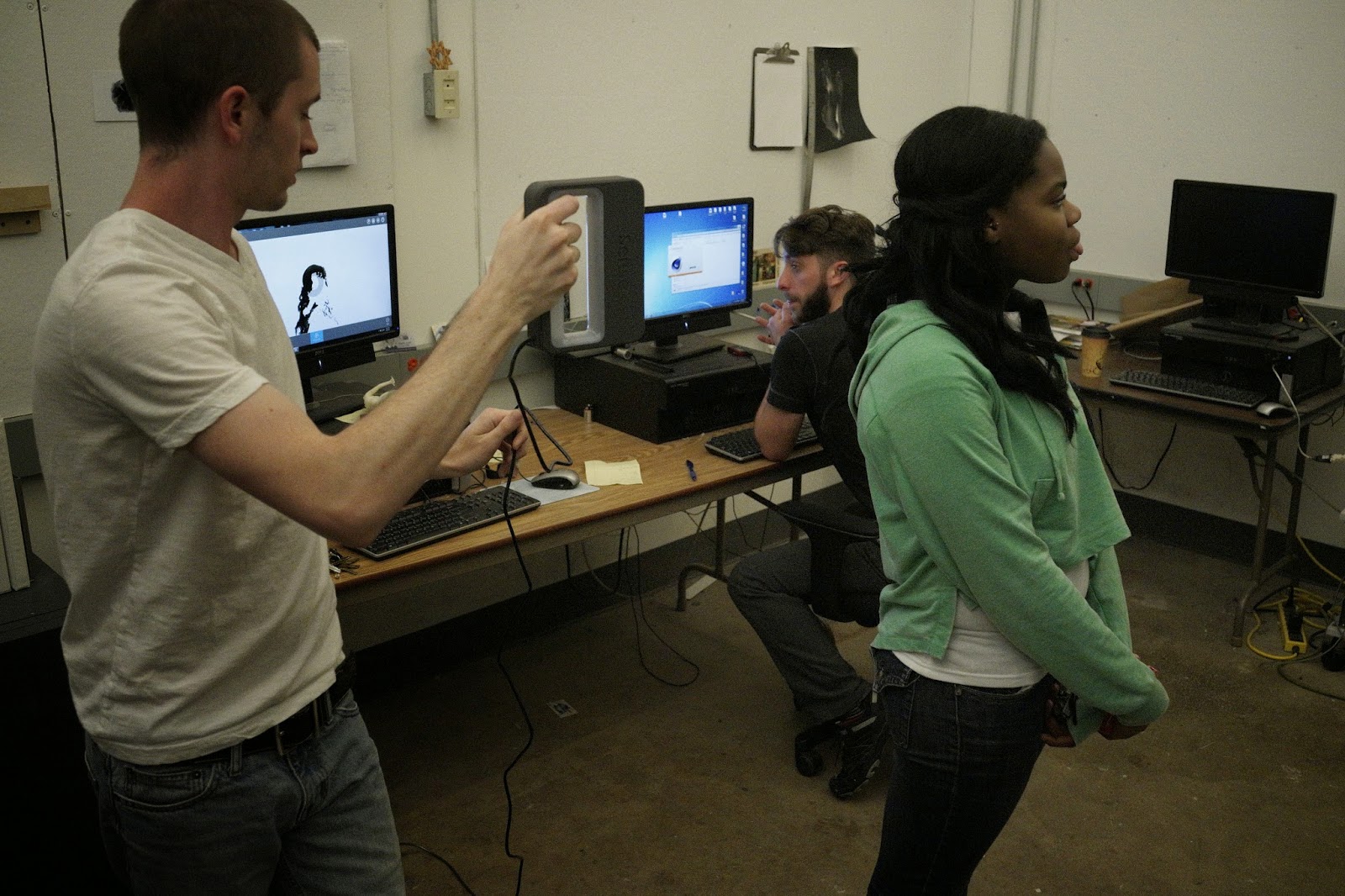
Students first were introduced to a scanner technology that the graduate students used to scan the heads of each student into the computer. This process was very interesting and students could track the progress of their scan visually on the computer monitor.
Above/Below: Tyler Zeleny scans a STEAM student's head
Students then engaged with the MAC computers in the lab where Sculptris and other software are available to the WPU student users. GOPA and SOIT students experimented with Sculptris, a three D digital sculpting software that produces striking results in a short time.
Above: STEAM students experience Sculptris
After lunch Professor Rees took the students on a tour of the wall relief projects hanging in the halls outside of the computer lab done in Professor Rees' university art class. WPU graduate art student, Kelly Boguscz, shared several of her works with the students. This group of relief sculptures and their accompanying QR codes provoked a thoughtful and critical dialogue by the STEAM students with Professor Rees.
Above: Michael Rees, Marilyn Simon, and STEAM Students
Then the students returned to the computer lab where they found that the scans of their heads done earlier were available to them digitally for them to manipulate using three D modeling software. Professor Rees demonstrated some possibilities using the software on a large screen in front of the students.
Above: Michael Rees demonstrates digital sculpting to STEAM students
Students had an inspiring time experimenting with the software options and inventing new possibilities for their 3-D portraits. They created a wide range of interesting and provocative art pieces. (See below.)
At
the end of the day one of the scanned portraits from the morning was printed by the
three D printer. The rest of the students
will receive their portraits next week when Professor Rees returns to
Eastside High School. The STEAM students will continue working on these projects in Mr. Jones' and Mrs. Simon's STEAM classes.
Left: Michael Rees and a STEAM student with the portrait created by the three D printer.