Tuesday, January 13, 2015

Kaleiodoscopes at School 2


A kaleidoscope may appear to be a cylinder, but 5th grade students at School 2 know that it actually contains a triangular prism.  The kaleidoscope works when the three sides of the prism, which are composed of mirrors or mirror-like material, reflect light entering through a colorful end, creating a colorful pattern because of the reflections off the mirrors.

The students learned this by making their own kaleidoscopes, a joint project developed by WPU Math Professor in Residence Paul Odenwelder and WPU Art Professor in Residence Simone Sandler.  

The project integrated science (the science of light, the principle of reflection) and math (terminology such as rectangle, circle, triangle, angle and triangular prism.)  


Math Pir Odenwelder (foreground) and Art PIR Sandler (rear left) assist students in the construction of their kaleidoscopes.


The hands-on activity engaged students in engineering principles. The activity also required students to follow directions carefully. 


Students build the triangular prisms that form the internal reflective surfaces of the kaleidoscopes.  Accurate measurements were essential to ensure the correct functioning of the final model.  In some cases, trial and error taught students the need for persistence in problem-solving.


Students create the individualized artworks, colorful abstract designs that form the end of their kaleidoscopes, and which produce the symmetrical pattern seen through the eyepiece.


 Students enjoy the results of their efforts, viewing the colorful pattens produced by their kaleidoscopes.


School 2's WPU Math Professor in Residence Paul Odenwelder is funded through the Garden State Partnership for teacher Quality, and WPU art Professor in Residence Simone Sandler is funded by the Geraldine R. Dodge Foundation Grant.

Monday, January 12, 2015

Part One: GOPA Steam Students visit local historical and cultural sites


     On December 18, 2014, School of Government students visited two important historical and cultural sites in Paterson on a field trip to find out more about their very own city.  GOPA STEAM students with Art Teacher Darryl Jones, Science PIR Dina Scacchetti, and Art PIR Triada Samaras visited both the Paterson Great Falls National Historical Park and the Paterson Museum in a fact finding and exploratory mission that underlies the STEAM project being developed in Mr. Jones' classroom.  

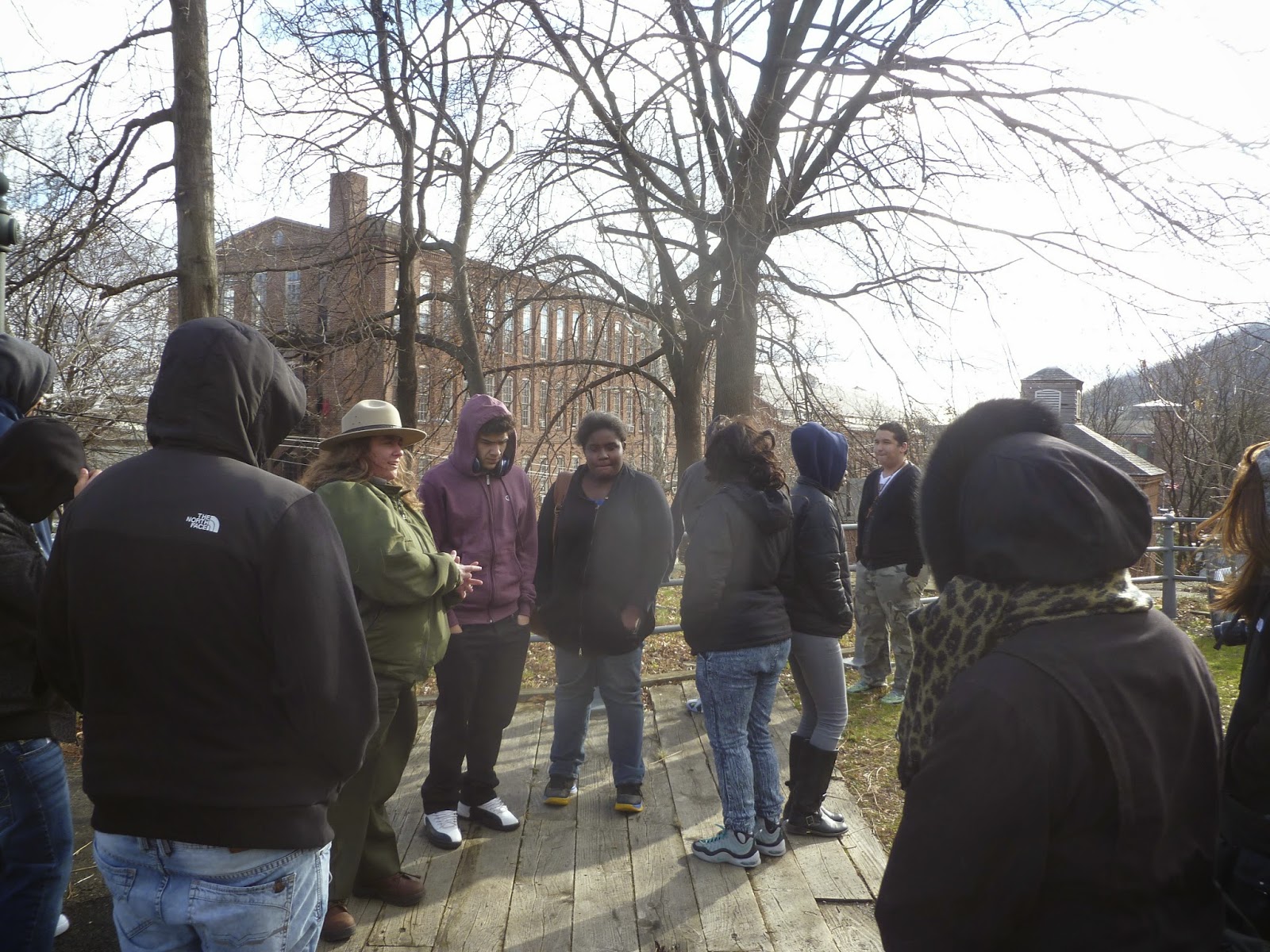
     At Paterson Great Falls National Park, Park Ranger Ilyse Goldman explained to students in great detail the rich history of the Paterson Great Falls and its role in the industrial success of early America.  For example, Alexander Hamilton chose the site of the falls to launch his brainchild, America's first planned industrial city called the "national manufactory."  GOPA students learned Hamilton realized the powerful potential of these roaring falls to generate energy for the mills that later made Paterson famous as an industrial hub and contributed to the economic success of our still young nation.

STEAM students observed the cascading water and the surrounding landscape and imagined what the early American settlers dreamed of building and doing upon encountering this natural wonder. In other words they were exposed to the same creative process they encounter in their art classrooms.


During this field trip students were exposed to many configurations of art, history, math, science  and engineering as they came to understand the purpose of the raceways, the method by which water was diverted from the falls to be used to generate power for the variety of mills that made Paterson so successful. They came to see their city in a new creative light that is the perfect segue to their STEAM art and research studies in the classroom.


From the Great Falls Overlook, students proceeded south toward the Paterson Museum, viewing the upper raceway and gaining an understanding of just how the power of the falls was utilized.


Ranger Goldman explained that the raceways were now dry because after Hurricane Irene, they had been damaged so badly that they were no longer able to hold water, and posed a threat to nearby buildings.
Maps trace the old raceway system through the modern City of Paterson.


As an added bonus, STEAM students saw the arrival of what will be the new clock for the Paterson Historical District.


(See Part Two for more details of this STEAM field trip.)


Part Two: GOPA Steam Students visit local historical and cultural sites

(See Part One for more details of this field trip)


After lunch, GOPA STEAM students students observed an important dedication ceremony at the Paterson Museum attended by two members of Congress representing New Jersey.  Students learned how the efforts of Rep. Bill Pascrell Jr. and Sen. Bob Menendez prevailed in Washington earlier in the year, making Hinchcliffe Stadium, one of the last remaining stadiums where Negro baseball was played, a part of the National Park system.


To Senator Menendez and Representive Pascrell Hinchliffe Stadium is the symbol of a dark time in American history and needs to be preserved.  

"I believe strongly that the story of our fight
against institutionalized segregation is a
story worth telling," Menendez said. "When
I look at Hinchliffe Stadium, I see a field of
dreams. . . an enduring reminder of how far we've come since the days of separate but equal, when institutional segregation marginalized the work, dreams, and achievements of African-Americans.  Protecting the history of urban communities Pascrell said, "is just as important as protecting our wilderness and natural wonders out West."


After the ceremony, STEAM students were led on a tour of the Paterson Museum exhibits by Mr. Robert Veronelli, and engaged with a wide variety of historical artifacts including textile making machines, native architecture, locomotive manufacturing parts, early submarines and airplanes, pharmaceuticals, models of factories and much more.


Students were enthralled to imagine their city in a historical light and as well as an imaginative one. They came to understand their city of Paterson was once a place of great creativity as well as inventions.  In addition they saw Paterson's unique and inspiring role in the development of our early American history.


This field trip was a perfect segue to their own STEAM project in the classroom utilizing the five subjects of science, technology, engineering, art, and math in synergy and leaving Mr. Jones' class with plenty to talk about when it comes to improving today's Paterson based on the perspective they have now gained.


Wednesday, November 12, 2014

GOPA STEAM students go to WPU on an artistic adventure

On November 3rd, STEAM students from GOPA/School of Government participated in a field trip to William Paterson University in which they learned about the work of Artist in Residence Maria Lux.  Award-winning visual artist Lux has created artwork spanning a wide range of media from traditional drawing and painting methods, watercolor illustration, and scientific diagrams, to photography, dioramas, wooden constructions, and large-scale sculpture. 

Lux provided a 45-minute lecture in the Cheng library auditorium, discussing her artistic practice and recent work. She explained her creative process: how her work begins with existing research and stories from other fields—such as evolutionary biology, medicine, agriculture, history, literature, film, and anthropology—and uses the tools of visual artistic practice to create cross-disciplinary, installation-based works.


Students then traveled to the Art Department’s Power Arts facility, where they visited the Center for New Art’s laboratories (which include a CNC mill, 3D printers, and 3D scanner). They also visited Lux’s studio, and viewed current exhibitions in the Power Arts Gallery (which include student artwork).


After lunch the students engaged in a walking tour of the WPU Outdoor Sculpture Program led by Kristen Evangelista, Director of the University Galleries.


Lux will be in residence at WPU from October 6 – November 14, 2014.  The residency will culminate in a solo exhibition on view from January 20 – March 27, 2015 at the University Galleries with an accompanying publication.  A follow-up field trip in February will take students to the University Galleries to see the outcome of her residency.

Back in the GOPA classroom in Paterson, NJ, Art Teacher Mr. Jones engaged the STEAM students in a thoughtful discussion about their field trip.  A meaningful learning moment took place when one STEAM student stated he was surprised that Mr. Jones had expressed his reservatioms about what he had seen on the artist's website to the artist while on the field trip.  Mr. Jones further encouraged the student to express his feelings, and the point was made that art discussions can provoke controversy.  Mr. Jones explained that the expression of the true feelings of each person in an art dialogue allow for the honest dialogue that is essential to the art process.  

Sunday, November 9, 2014

STEAM curriculum continues to grow at SOIT

The STEAM curriculum at SOIT/School of Information and Technology in Paterson, NJ has continued to evolve this year.


STEAM students in Mrs. Simon's Art Class are creating Cubist paintings using watercolor pencils and brushes on large-sized white paper. The c. 22 x 28 inch white papers are being drawn first with pencil by the students then painted later taking their inspiration from Picasso Cubist works.  


STEAM students learned that Cubism is an early-20th-century avant-garde art movement pioneered by Georges Braque and Pablo Picasso, joined by Juan Gris, Fernand Leger, and many other well-known artists that revolutionized European painting, sculpture, and inspired related movements in music, literature, and architecture.  Cubism has been considered the most influential art movement of the 20th century.  Arriving at the concept of depicting an object as seen from different viewpoints independently, Pablo Picasso and Georges Braque soon became good friends and went on to develop the visual language of cubism in close cooperation, an alliance that Picasso would sometimes call a marriage.


In addition to creating artworks, students made a virtual tour via Smartboard to the Metropolitan Musuem of Art in New York City where a current exhibition of Cubism is on display.  Art teacher Mrs. Simons pointed out the many connections Cubism has with geometric forms.


Dodge Funded STEAM Program is off to an enthusiastic start at CAHTS

The Geraldine R. Dodge Foundation funded STEAM Program is off to an enthusiastic start at the CAHTS/Culinary Arts, Hospitality, and Tourism School in Paterson, NJ this year!

STEAM students in Ms. Reyes’s Art Class are creating two point perspective cities using acrylic paint and brushes on canvas boards.  The 12 x 16 inch boards are being painted on table easels by drawing a sketch first with pencil then painting later.  The goal of this art project is for the students to understand how objects and buildings appear to get smaller in the distance, and how to create this effect artistically by using linear perspective methods created in Renaissance Italy by Fillipo Brunelleschi. 


Around 1420, Brunelleschi demonstrated the geometrical method of perspective, used today by artists, by painting the outlines of Florentine buildings onto a mirror.  When the building’s outline was continued, he noticed that all of the lines converged onto the horizon line. Ms. Reyes’s art students re-created these experiments in the classroom using a mirror before they began their paintings.  In so doing, students understood the close connection between linear perspective in art and mathematics, especially geometry. Later in history Leon Battista Alberti, an Italian architect, added mathematics to Brunelleschi’s findings.


STEAM students in Ms. Reyes' CAHTS class are also learning scientific principles in this art project, or how an imagined light source in their artwork can create three dimensionality through color changes the students can utilize as they paint.  Light plays a critical part in these artworks.  Thus, students are learning to using mix colors that create three dimensions in their buildings and roads, and make them appear as though they recede in space toward the horizon line.


In addition these art students are learning to create both aerial and atmospheric perspective in there artworks.  These techniques were used to make buildings in paintings look three dimensional in the Netherlands in the 15th century and even as early as 30 B.C.E. in Ancient Rome.


Monday, October 27, 2014

STEAM "Living Things" Project at School 2 in Paterson, NJ

     At School 2 in Paterson NJ, fourth grade students engaged in a project-based learning activity (PBL) to learn about cells in their unit “Living Things.”  Using diagrams of cells the students identified the various parts of the cell, and compared and contrasted the parts of plant and animal cells.  

     The vocabulary and concepts were reinforced by a hands-on art/science activity in which students, working in pairs, created 3D models of their cells.  


      Upon completion of the project students discussed their cell projects in front of the class, both in terms of the scientific concepts and terminology, and the elements of art.