Monday, December 7, 2015

Eastside Students Attend a Field Trip to Ben Shahn Galleries at WPU

Students from Eastside’s School of Government, School of Information Technology, and School of Culinary Arts recently attended the exhibition “Recent Indigenous Art of India” at William Paterson University’s Ben Shahn Galleries.  Accompanied by their teachers Darryl Jones, Marilyn Simon, and Vivian Reyes, the students toured the art exhibition under the tutelage of Gallery Director Kristen Evangelista. WPU Professors in Residence Triada Samaras and Dina Scacchetti also accompanied the students.

Students began their day with a gallery tour by Director Kristen Evangelista.  They visited the exhibition: 
Many Visions, Many Versions: Art from Indigenous Communities in India
November 2 - December 11, 2015
Court, East and South Galleries
Co-curated by Aurogeeta Das and David Stanton, this exhibition features work from the Umesh and Sunanda Gaur Collection and the Ethnic Arts Foundation Collection LINK

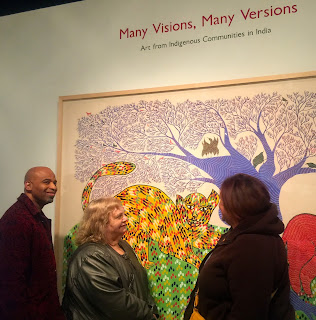
                Above: Eastside Art teachers from left to right: Darryl Jones, Marilyn Simon, Vivian Reyes

"This exhibition features the work of various contemporary artists from four major indigenous artistic traditions in India. It endeavors to increase the appreciation and understanding of indigenous art from India, which is rarely displayed in the United States." 

"On view at the William Paterson University Galleries, this exhibition showcases four of the most prolific communities producing indigenous art in India: the Gond and Warli tribes, and the Mithila and Chitrakar communities in the states of Bihar and Bengal, respectively. The works are drawn from the Ethnic Arts Foundation Collection and BINDU modern, home of the Sunanda and Umesh Gaur Collection." LINK

Right: Gallery Director Kristen Evangelista leads an art discussion with Eastside students

Above: Geraldine R. Dodge STEAM Grant Coordinator Dina Scacchetti listens to the art talk

The exhibition was organized into four broad themes:  Myth and Cosmology, Nature—Real or Imagined, Village Life, and Contemporary Explorations.  As they viewed the artworks, the students noted the use of geometric patterns, symmetry and proportion.  Also of note was the use of pigments obtained from unexpected natural sources—such as mud and cow dung!

                     Above:  Kristen Evangelista talks about a beautiful piece of art created on a cow dung background. 

Above: Emily Johnsen, Gallery Manager, introduces the hands-on art workshop that followed the art talk in the galleries

The students then created their own artworks inspired by the themes and patterns they had seen.  Emily Johnsen, Gallery Manager, explained the task, and the students set to work.  The students created Rangoli designs, patterns and geometric shapes often made of objects from nature such as leaves, flower petals, etc.  Symmetry often governs the design

Above Left:  
                                                                          WPU Art PIR Triada Samaras works with a student painting leaves


A visit from Michelle DeMartino, Assistant Admissions Director from the WPU Admissions Office, provided them with information about college and art careers: 

Additional activities also included visits to ongoing art classes.  Students viewed a drawing class with Professor Robles, and a ceramics class with Professor Lorenz, in which the professor was instructing the students in how to integrate technology (computer graphics and 3D printing) into their projects. 

Sunday, November 1, 2015

STEAM at School 29: Engaging Teachers and Students

Teachers at School 29 recently engaged in STEAM professional development in which Art PIR Myra Winter presented a lesson on creating “foldables”.  “Foldables” are three-dimensional interactive graphic organizers that enhance student engagement and learning. 


One popular “foldable” was a student “First Aid Kit”, in which students select what significant concepts or facts are most critical, and organize them into a “kit”.  After Ms. Winters’ introduction, teachers had the opportunity to try their hands at the task.


  The room was soon buzzing with math teachers identifying ways they could utilize this tool to help students better understand key concepts, including geometry principles and vocabulary.  Language arts teachers realized that “foldables” could serve as a means for students to tells stories and share creative writing ideas. 


STEAM is also taking place in classrooms!  When second grade teacher Ms. Taliercio began to teach her students the water cycle, she realized that they could benefit from a hands-on art-related project.  She reached out to Art PIR Myra Winter, who suggested a simple collage approach. Providing the teacher with the materials as well as guidance, Ms. Winter visited the classroom and reinforced the content while modeling how the students could create their own visual representations of the water cycle.  Students were actively engaged and proud to show their creations.

Friday, October 30, 2015

Race Cars, Color Lines, and Planets at NRC


Mrs. Moose, math teacher for students grades 6-8 at NRC, recently used a lesson in her classroom from the William Paterson University Summer STEAM Workshop held in July 2015 for all Paterson Public School teachers.
This activity was very popular with teachers who attended the Summer STEAM Workshop.  Her sixth grade math students engaged in a STEAM activity, in which they built, tested, and compared their own mini-race cars.  Students measured the distance traveled by the cars on the floor as part of their math learning.


In Mrs. Moose's seventh grade class, math students created a color line and engaged in a Straight Line Board Game.


Mrs. Moose's eighth grade students created planet artworks and calculated the distance to the planets. All of these STEAM activities make math interesting and engaging for these students. STEAM activities also create collaborations in the class, teamwork, and motivation.


Above:  NRC Math Teacher Mrs. Moose with tow of her eighth grade students.


Thursday, October 29, 2015

WPU Art Practicum Student Creates STEAM Lesson at SOIT School of Information Technology

Leaves and Landscapes

Above:  WPU Practicum Student with her finished student art works

WPU Art Practicum Student Ashley Zampino, who is working with SOIT/School of Information Technology Art Teacher Marilyn Simon, recently taught an enjoyable STEAM  art lesson to high school students that focused upon several elements of art and nature. 


Students first painted a selected landscape in watercolor, using both warm and cool colors.  They created a natural and outdoor space on these papers.  Next they used actual leaf shapes to create leaf prints on tissue paper, painting the leaves with acrylic paints to mimic nature.


In addition, students painted directly onto the tissue paper aiming to produce the look of natural leaf textures. 


Finally students attached their leaf prints to their watercolor landscapes. The finished artworks allow the viewer to look into an interesting landscape painting and experience the effect of leaves falling right in front of the their eyes.

Technology, Art, and Art History STEAM project at NRC!


NRC's technology teacher, Mrs. Selino, and NRC science teachers, Ms. Cunningham, Ms. McGee, Ms. Chiquito, Ms. Cruz, and Ms. Garcia recently collaborated on an innovative STEAM project.

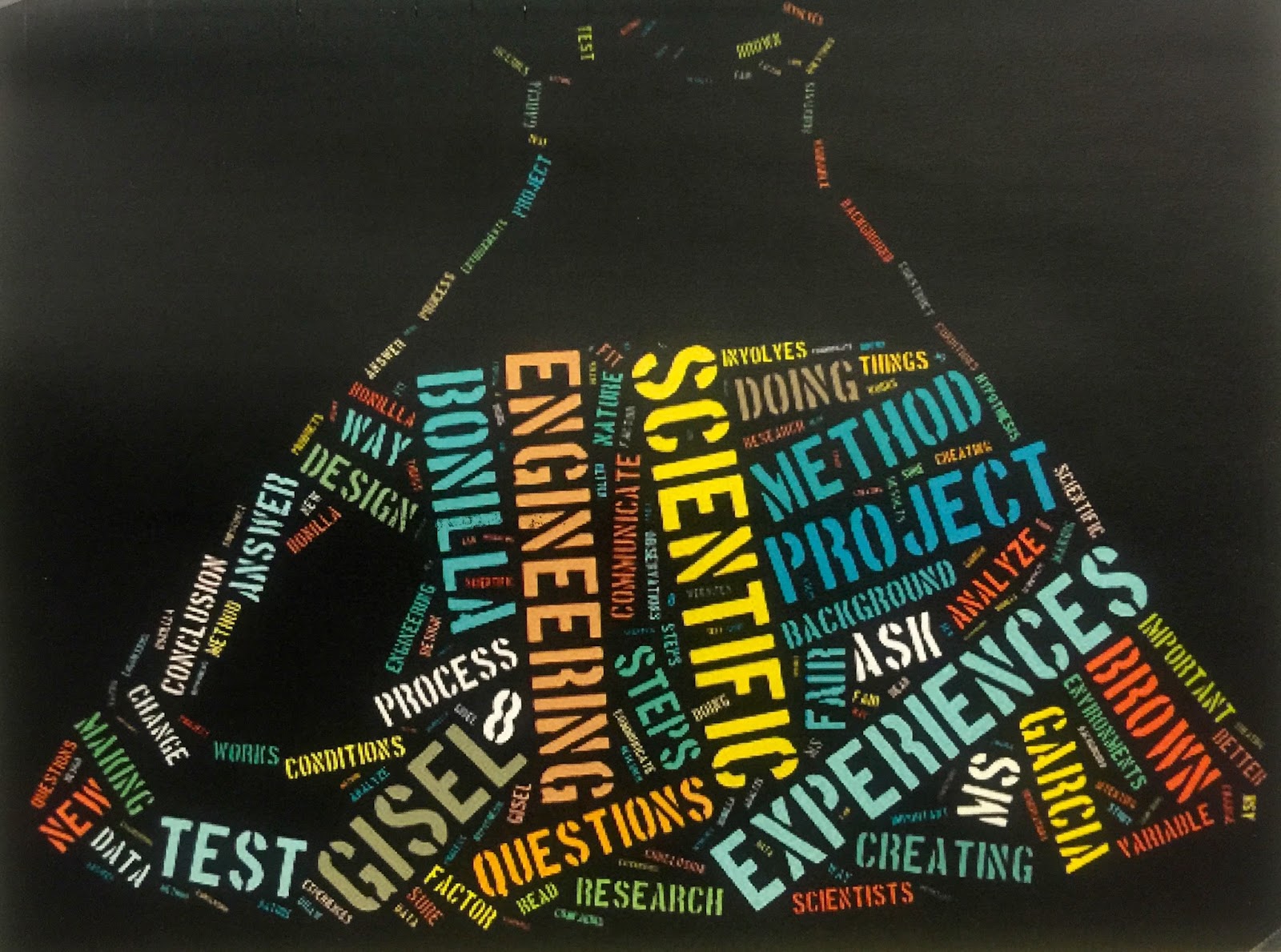
In this project, students used Scientific Method vocabulary words from their science classes in their technology class to create a Tagxedo* project with Mrs. Selino.

Above and left:  Janette Selino, Technology Teacher at NRC proudly points to the student work.


Students were first directed to science sites on their computers in technology class to find a general image relating to any scientific area. Then, Mrs. Selino explained how to fill this image with their scientific vocabulary words from science class as well as their name, their respective science teacher’s name, their university name and their grade. Students responded with excitement, saying, for example, “Wow, we are learning these same words in science class!”


The whole purpose of STEAM is to create collaborations between art, science, math, engineering and technology teachers so that students can make connections throughout their day between the distinct subject areas, and also see them as the unified whole these subject areas actually are.  STEAM works for teachers as well as for students, and both teaching and learning are constantly taking place in this process.

(A special thanks to the Dodge Foundation from the NRC Staff!)


Tagxedo runs words into visually stunning word clouds.  See tagxedo.com for more information

Friday, October 23, 2015

Another New STEAM School in Paterson, NJ: School 12


Two engaging and enjoyable science/art projects are in the works at School 12 in Paterson, NJ as part of the new STEAM program at School 12.


The STEAM program in Paterson has grown to include not only School 12 but also School 29, and the New Roberto Clemente School, making the total STEAM schools now eight this year.

With the assistance of Art Professor in Residence Simone Sandler, the 6th graders in Ms. Albritton’s science class are in the midst of building their own miniature cars to learn about Newton’s Laws of Motion. Students are constructing chassis from recycled juice boxes. They are then measuring carefully to construct functional axles and wheels from straws and life-savers.  Wrapping their chassis in thin white paper and using colored markers give students the opportunity to personalize their vehicles.

Working in teams, students are going outside and experimenting with their cars by sending them down ramps (inclined planes) set at different angles.  Using stopwatches and rulers, students take turns racing their cars down the ramps and measuring the distance and time for each car.  The calculations are being used to determine the speed of each vehicle.

Essential questions for the follow-up of this lesson include:
           1.  What made a difference in the speed of the cars? 
            2.  Was the slope of the ramps a factor? 
            3.  Was the roughness of the surface of the ramps a factor?
            4.  How does resistance affect a car’s speed?
            5.  How can cars be made to travel faster?

This hands-on experience inspired the students to develop critical thinking skills while problem solving with their peers.

In another School 12 classroom, a different STEAM project is being developed focusing upon biology and art.  As part of their science curriculum, students in Mrs. Krisak’s 4th grade class are studying plant and animal cells.  With the assistance of Art Professor in Residence Simone Sandler, students are using Styrofoam trays recycled from lunch.  They are working in pairs to draw and color the parts of the cell, and, using toothpicks, to identify and label the 


different parts.  In the process students will analyze the similarities and differences between plant and animal cells, and learn how to distinguish between them. This activity enables students to better retain information. Working in pairs encourages cooperation and communication skills.

New STEAM School in Paterson, NJ: The New Roberto Clemente School

     A vibrant and interesting technology/art/art history collaboration was recently created at NRC/New Roberto Clemente School in Paterson, NJ as part of the new STEAM program at NRC.  The STEAM program in Paterson has grown to include not only NRC but also Schools 12 and 29, making the total STEAM schools now eight this year.


     At NRC, WPU Art Professor in Residence Triada Samaras joins Professor in Residence, Betsy Golden and STEAM Grant Co-ordinator/PIR Dina Scacchetti to implement a new STEAM program at NRC.


Left:  
Three participating teachers at NRC left to right: Ms. Mandal Art, Ms. Selino Technology, Ms. Senopole Art,
This STEAM collaboration was created In celebration of Hispanic Hispanic Heritage Month month in October at NRC and combines art, art history, and technology.  Students researched prominent Hispanic artists and featured them in colorful and creative posters made with technology.  Students worked with two art teachers, Ms. Senopole, and Ms. Mandal, as well as Ms. Selino, technology teacher.

Above: Ms. Selino, technology teacher stands in front of one of the 
bulletin boards in the hallway

Below:  Two Examples of NRC Student Work done for this project using art, art history and technology.


 A rubric was given to each student for assessment purposes:


In other classrooms at NRC, STEAM is manifesting in other ways.  Ms. Munem's social studies classes, grades 6-8, used art to learn science.


Above and below:
Ms. Munem exhibits student's use of artistic strips and markers to study the research method.


Above and right: Ms. Cuningham, 8th grade science teacher, has her science students using art materials and various "foldables" techniques to make individualized and creative science journals.


Left:  WPU Art Professor in Residence, Triada Samaras, admires a bi-lingual STEAM bulletin board created by Ms. Gonzalez, bi-lingual teacher.