Wednesday, June 1, 2016

STEAM Art Project at GOPA: Math, Science, and Art

In Mr. Jones's art classes at GOPA, students have been studying both 2-D and 3-D painting on masks, incorporating aspects of mathematics with art.  Students began this intriguing project by creating their 3-D masks using wet, plaster bandages to wrap over the forms of original plastic face masks. They next attached these masks firmly to a background made out of chipboard. 

Next the students copied the facial features of their mask onto a piece of white paper.  Using geometry, they made sure that the proportions were the same as the original.  Next, Mr. Jones asked them to experiment with paint on this paper to determine how they wished to eventually paint their 3-D masks.  
Using the mathematical concepts of ratio and proportion, they mixed pigments using various proportions and combinations to find the colors they wanted to use on their final mask.
When they were ready, they applied paint in precisely the same manner to the plaster-bandaged masks.  They re-created their colors using the same proportions of pigments for each color as they had used previously on paper.


In addition, Mr. Jone's art students have been working in the medium of pottery. Their small pot study (pictured below) requires them to learn about science as well as art.  Students initially observe while dry clay from last year gets re-cycled and re-conditioned to become moist, usable clay.  All discarded clay, except that which comes into contact with plaster or other contaminants, is recyclable and reusable.
LINK
To make symmetrical clay pots, students use geometrical measurement to calculate how much clay belongs on both the right and left side, and the top and bottom of their vessel.  In addition they must calculate the opening and how wide it can be.  Later, In the firing process of the small clay pots, students learn more science as they come to understand the difference between low-fire and high-fire glazes, and the process by which the glaze melts in the heat of the kiln.  In addition, students learn that leaving even small air bubbles in their clay vessel will cause it to explode in the heat of the kiln.  Below Mr. Jones is pictured with some of his students' clay works.

Acrylic Paintings of Trees Create a Science/Art STEAM Project at CAHTS

In Ms. Reyes's classes at CAHTS, art students have been learning about trees and creating acrylic landscape paintings in a science/art STEAM project.  Students first researched on the Internet to find landscapes of trees they admired.  This research also involved learning about the types of tree in each landscape:  its natural habitat, its reproduction, its life cycle, and other important features.  For example students learned that one large tree can provide an oxygen supply for two people.  Students were impressed to learn the net cooling effect of a young, healthy tree is equivalent to ten room-size air conditioners operating 20 hours a day.  LINK

Next students sketched their landscapes onto white paper using pencil.  Their drawing skills have been increasing all year with Ms. Reyes' instruction.
Later students learned how to mix and match colors with acrylic paints.  Previously they had learned how to create a color wheel and color charts in Ms. Reyes' class.  This color theory knowledge gave them the skills to create the acrylic colors for their landscape paintings that they wished.  

Color theory is a science, as colors not only have different hues, but also different tints and tones.  For students to find a particular green, for example, they must consider the hue, lightness or darkness and the color intensity of the green they desire. Each type of paint pigment handles differently.  LINK
Ms. Reyes introduced an acrylic retardant to the class and students experimented with this medium to delay the drying times of the paint.  

Next students investigated more deeply into the types of trees in their landscapes. Again, they used the Internet.  From their notes, students created a research paper for this project, using their new knowledge about trees to inform this paper. Eventually, students will display their finished paintings and papers in a glass display case at CAHTS.


Wednesday, May 25, 2016

STEAM Art Projects Continue to Expand at NRC/New Roberto Clemente School

At the New Roberto Clemente School, a new collaborative STEAM art project is in the works. Led by Geraldine R. Dodge-funded STEAM Art Professor in Residence Triada Samaras, NRC teachers in all content areas are brainstorming a collaborative STEAM quilt.  This school-wide art project will be eventually hung in the student cafeteria of the NRC building.  Students who attend NRC on Saturdays will be able to gaze upon and interact with this quilt as well as students eating lunch in the cafeteria all week long.
The idea for this quilt first arose after the success of the large, collaborative paper hanging sculpture, Racimo of Reflection, specifically at the All Paterson Student Art Exhibition in March 2016.  LINK  Creating Racimo of Reflection collectively inspired teachers to brainstorm a second collaborative STEAM project and Art PIR Triada Samaras encouraged the teachers to think outside the box.
The idea for a "quilt" arose when art teacher Wendy Roche created the first “prototype” of a quilt piece, inspiring the rest of the teachers to think creatively with her.  Teachers decided that any classroom who wished could produce a quilt square with their students in the classrooms.  In addition, teachers decided that each square would communicate something about their subject using art materials.  The quilt- project would moreover be a way to de-stress the students after strenuous testing this month, e.g. the PARCC Assessment.

Technology teacher Janette Selino suggested that the quilt squares be entered into a school-wide competition for an end of year prize.  (Enrollment in this competition will be strictly voluntary.) In the past few weeks, teacher interest and participation are quickly growing. Teachers that have not yet participated in a STEAM project at NRC are now excited to join the new STEAM collaboration. More quilt news to come!
 
Above Left;
Colorful chart created by art teacher Wendy Roche to illuminate the infinite possibilities using folded paper on a quilt piece to achieve a wide variety of visual effects.
Sketch above by art teacher Wendy Roche who first envisioned the quilt to be a sort of tapestry.

In other STEAM news at NRC:
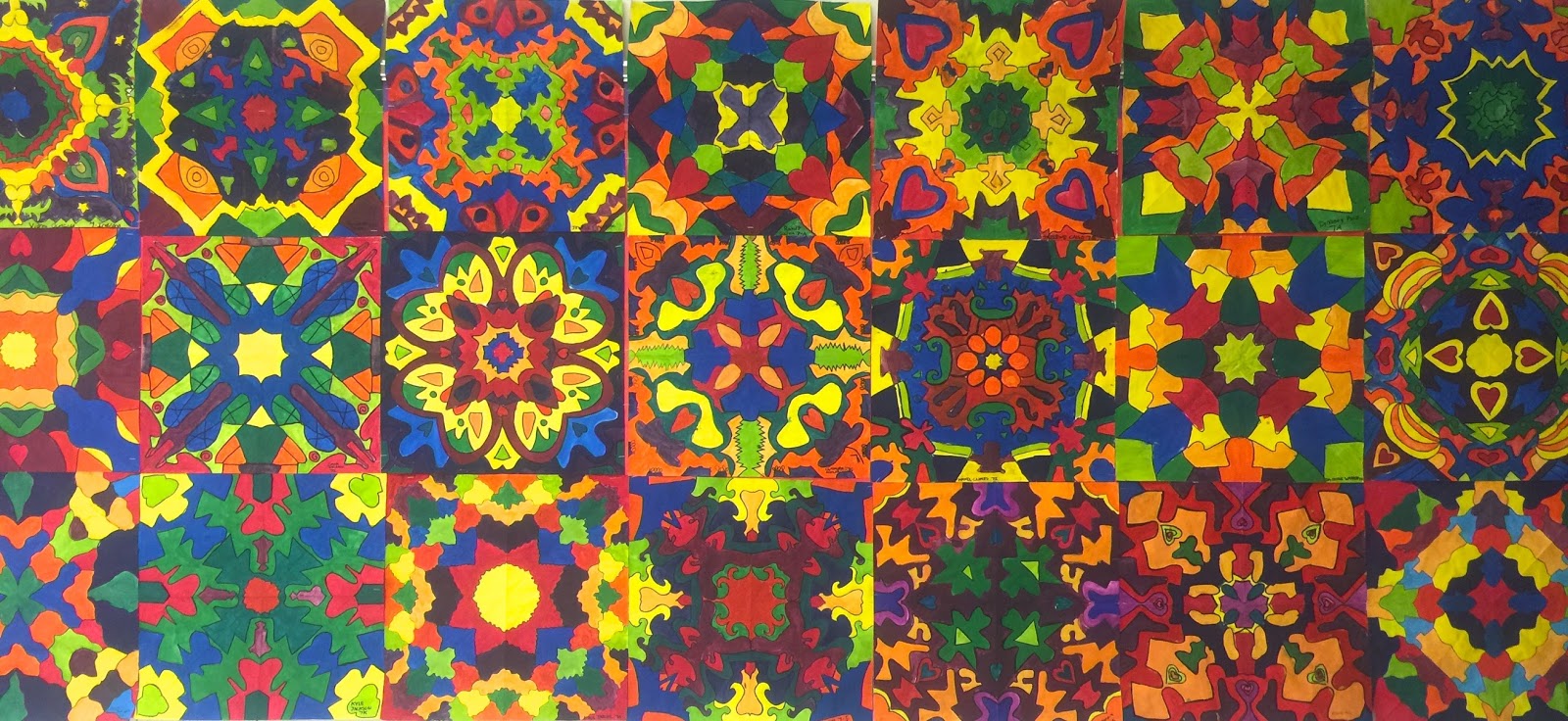
Ms. Monique Aramayo, art teacher has been doing a math/art project with her students.  Teaching them about radial symmetry and the mathematical components of a symmetrical circle pattern, Ms. Aramayo has encouraged her students to draw with pencil, then paint with tempera to create these extraordinary paintings.


Taken together as a whole these radial symmetry paintings resemble a large rug or beautiful wall hanging.
Students worked on these radial symmetry paintings with paints and papers provided by the Geraldine R. Dodge STEAM grant.


In another new technology/art STEAM project, Ms. Monique Aramayo (pictured above) demonstrates the use of technology to assess her art students using an app named Plickers. This powerful tool allows teachers to collect real-time formative assessment data without the need for student devices. Below are the materials created by Ms. Aramayo for her students to use when she is collecting data with Plickers.
In the “Basket of Math” project (see images below) , math teacher Ms. Vancheri collaborated with art teacher Ms. Roche to create this colorful and artistic basket of equations.  Ms. Vancheri had students utilize the Pythagorean Theorem to determine unknown side lengths of right triangles to solve mathematical problems.  (See rubric below.)  In addition math students wrote their equations onto colorful egg shapes.  With the help of art teacher Ms Roche, a delightful handwoven basket was created, making the math wall visually as well as mathematically inspiring.

In the lobby of NRC, 8th grade algebra teacher Ms. Natalie Diaz (pictured below) created a spectacular bulletin board celebrating Albert Einstein and National Pi Day.  Her students worked with the Sierpinski Triangle (see below) and created new formations that were placed onto this bulletin board.
 
The Sierpinski Triangle is a mathematically generated pattern that can be reproducible at any magnification or reduction. It is named after the Polish mathematician Waclaw Sierpiński but appeared as a decorative pattern many centuries prior to the work of Sierpiński. LINK
Ms Diaz also taught her students about the Menger Sponge (see above).  In mathematics, the Menger sponge (also known as the Menger universal curve) is a fractal curve. It is a three-dimensional generalization of the Sierpinski carpet, though it is slightly different from a Sierpinski Sponge.  The Menger sponge simultaneously exhibits an infinite surface area and zero volume.  LINK


In addition several fabulous STEAM bulletin boards have been recently created throughout NRC by teachers of various disciplines. Below, science and social studies teacher Ms. Munem explains how her interactive "Renewable vs. Non-Renewable Energy Sources" bulletin board combines art and science.


Another inspiring example is Ms. Flores's Spanish class which created an interactive Art/Spanish/Science bulletin board using the same art strips used for the NRC Racimo of Reflection project in a whole new way.


Monday, May 16, 2016

Adding Trees at School 2

At School 2 Mrs. Casais’ second grade students were learning to solve addition problems in math.   At the same time, in science, they were studying the structure and function of trees, and how important trees are to our lives.  Students engaged in a project that incorporated both these math and science topics.  
 

Working in pairs, the students were asked to design and create tree houses out of popsicle sticks, markers, crayons, yarn, and recycled cardboard.  A requirement was that each tree had to incorporate a certain addition number fact. 


Art PIR Sandler, who developed the lesson, showed the students photos of houses being built so they could observe the importance of shapes in house construction.  The students had to take into consideration such topics as:  what shapes would they use to create their houses; could their trees support their houses; how would they get into their tree houses.  (Note the ladder in the picture below.)

Students encountered several difficult problems in the construction of their houses, but solved them by communicating with their partners and with the support of Mrs. Casais and Mrs. Sandler.

The students recorded their procedures and descriptions of their tree houses in their journals.

Monday, April 18, 2016

School 7 Seventh Grade Students Consider How to “Nurture Nature”

On March 31st, seventh grade students from Paterson School 7 spent the day at William Paterson University's Ben Shahn Art Galleries engaging in activities that integrated art and science.  They were accompanied by Science Teacher Marla Arrington, Student Teacher and Woodrow Wilson Fellow Sue DeNardo, Art Teacher Vernon Nealy, ScienceTeacher Tracy Pearson, Art PIR Myra Winter, and Geraldine R. Dodge Grant Coordinator Dina Scacchetti.

The day began with a tour of the current exhibition, Living Together: Nurturing Nature in the Built Environment.  This exhibition features living plants as well as photography, drawing, and collage, and addresses, “our complex, mediated, and often fraught relationship with the natural world.”  The exhibition ties in perfectly with a project-based learning effort that the seventh graders are engaged in:  the development of a sustainable village ecosystem, in which criteria such as food/water sources, energy sources, waste disposal/decomposition systems, habitat conservation, and architecture all have to be ecologically sound.  In the pictures below Director of University Galleries Kristen Evangelista leads the discussion about the exhibition.

In the picture at the right students interact with a “beanbag” chair created from recycled materials that mimic artifacts of nature.


After seeing the exhibition, the students adjourned to a classroom where Adjunct Professor Gina Miccinili, Gallery Manager Emily Johnsen, and Gallery Interns Kristina Sternesky and Mitchel Sybesma led the students in an art activity.  Each student was supplied with a terracotta flowerpot, and access to acrylic paints of various colors.  They were invited to paint the pots in individual and creative ways.  Some students’ work was very representational, while others developed abstract designs.

                
While the paint on the pots was drying, students toured the   College of Science and Health’s greenhouse, in which different rooms mimic different ecosystems.  Professor Michael Wyrwa showed students plants that have adapted to different environments in various ways.  For example cactus plants have adapted to desert environments by reducing their water loss.  Certain plants that grow in poor soil have developed means to “capture” insects and “digest” them to obtain needed nutrients.

The students also viewed some of the campus sculptures with Ms. Evangelista. In the process they identified and reviewed math vocabulary and concepts that were used in the creation of these artworks


Next, students returned to the classrooms, where the gallery interns gave a brief lesson on seed germination. 
 
The students then found their individual pots, filled them with potting soil, and planted seedlings of herbs, e.g. dill and/or basil.  They were provided with instructions on how to “nurture” their plant.


At the end of this highly productive and fascinating day, each student left with a painted pot in which a seedling had been planted.  Let’s hope they grow! Transportation for the trip was provided through William Paterson University’s Geraldine R. Dodge Foundation Grant.