Tuesday, October 11, 2016

Coming Soon to Paterson: Phase One: A "Virtual" Museum visit from the North Carolina Museum of Art!

Above:  The amulets of Nehebkau (left) and Isis and Horus (right) from Ancient Egypt printed out on a 
three D printer from scans of the objects made at the NC Museum of Art


This fall at NRC/New Roberto Clemente School in Paterson, NJ, the STEAM program will feature a  a "virtual" field trip to the North Carolina Museum of Art via videoconferencing.  Enhancing the visit will be 3D printing.  

This collaborative STEAM art project between the museum and NRC began when WPU STEAM Art Professor in Residence Triada Samaras, met North Carolina/NC Museum of Art Acting Director of Education Michelle Harrell in Raleigh, NC, where the art museum is located. Together they planned for a fall STEAM art collaboration between selected NRC teachers and students together with Distance Learning Educator Emily Koteki from the NC Museum of Art.  In the planned lesson Ms. Kotecki will interact directly with NRC students in the classroom from the museum Egyptian Wing, using videoconferencing.

For this project, NRC technology teachers will print 3D replicas of historical objects from the permanent Egyptian Art collection of the museum prior to the virtual class with Ms. Koteki. In this way NRC students will be able to have tangible objects to examine, thus engaging their interest and increasing their understanding of what they are learning. Students from technology classes and art classes at NRC will participate in these activities in November. In addition, history teacher Mr. Fusco's students, who are currently studying Egyptian history, will be attending.


Above:  Mr. Baldwin's trial 3-D prints of historical 
objects from the North Carolina Museum of Art Egyptian Wing

Mr. Baldwin, technology teacher at NRC, has developed an enormous interest in 3D printing in his classroom to date.  (He is also an expert in computers and video production.)  Mr. Baldwin already made model 3D prints of the amulets of Nehebkau (above, left) and Isis and Horus (above, right) from Ancient Egypt from scans of the objects made at the NC Museum of Art that were sent to him at NRC. When NRC acquires the larger format 3D printer, Mr. Baldwin will print these amulets at a larger scale, perhaps in color or in translucent filament.


Above pictures: Mr. Baldwin in his classroom with 3D design 
works done by him with his students in his technology classes last year.

In addition, Mr. Baldwin will assist both WPU Art PIR Triada Samaras and NRC technology teacher Janette Selino with setting up the videoconferencing in both classrooms. Mr. Baldwin hopes in the near future to acquire three large format and a grand scale 3D printer for his rapidly expanding technology program in his classroom.


More to come in the near future on this exciting project!

Monday, September 26, 2016

Summer STEAM Institute at William Paterson University


This past summer over forty teachers participated in an exciting two-day workshop that focused on integrating art into other core subject areas. These teachers were from schools participating in the University’s Geraldine R. Dodge Foundation STEAM grant and from other schools in the University’s Professional Development Schools network.  (STEAM, which stands for Science Technology Engineering Art Math, emphasizes the integration of all content areas to enhance learning and make it more meaningful.)
 
The workshop offered over twenty proven art-integrated lessons ranging from kindergarten through 12th grade that have been developed in prior years of the STEAM grant.  Participants were guided through their activities by professors in residence and by teachers who have been participating in the University’s Dodge grant for up to four years. 

The Institute leaders included: WPU Professors in Residence (Triada Samaras, Art; Simone Sandler, Art; Myra Winter, Art; and Paul Odenwelder, Math) and Paterson teachers (Darryl Jones, Art; Vivian Reyes, Art; Marilyn Simon, Art; Belinda Casais McBride, Elementary; and Michael Schulties, Science).  The "STEAM Team" shared their content knowledge, STEAM pedagogy, and STEAM expertise.

 
 At left, Art Teacher Jones prepares to illustrate how to use 3D to bring science lessons alive!  Mr. Jones also taught a lesson on cell phone photography.


 Meanwhile Math PIR Odenwelder explains how to teach geometry using orgigami and tesselations.


Art Teacher Simon describes a lesson that integrated art and engineering, in which students built a life-size model of King Tutankhamen.


All participants completed the workshop with an increased understanding of the vital role of art in the teaching of the other content areas.  Their engagement and enthusiasm is illustrated here

Because a major goal of the workshop is for teachers to develop their own arts-integrated lessons, a follow-up workshop has been scheduled for December 6, 2016,from 4:00 PM to 7:00 PM through the WPU Center for Continuing Education. Summer participants may demonstrate their newly-designed lessons, and new registrants are welcome.

Friday, June 24, 2016

Engineering Insects at School 2

Throughout the school year, students who qualified for enrichment during the daily intervention period were given the opportunity to engage in STEAM work with Art Teacher Ms. Porto and Science Teacher Mr. Colosimo.  A culminating project involved science, engineering, and art.

In this project the students created large sculptural models of insects.  Working in groups, they first researched insects on the Internet.  Each group selected one insect to be their group’s project.  They then further researched their choices, identifying characteristics that would ensure that their models would be reasonably scientifically accurate, although the main purpose was for them to be aesthetically beautiful.

The next step was to determine how to make a model of an insect that would be hundreds
of times larger than in real life.  Decisions had to be made regarding which materials to
choose that would provide the necessary structural support.  Then the actual work began!  (And the work was, at times, messy!) 


 It was also necessary to determine how best to connect different types of materials.  For example, if a wire framework was created for the wings, it had to be securely fastened to the body.


A great deal of trial and error took place.  In other words, the students had to apply engineering principles, generating creative solutions to the problem of constructing their models.


Once the basic frameworks were completed and filled in, the models were painted. 


The final results were dramatic and exciting!  In September these will be displayed in a central location so that the entire school can enjoy these works of art.


Thursday, June 23, 2016

School 12: Snakes and Shapes, Butterflies and Geometry, Artists and Cubes

Recently aPaterson School 12 teachers and students in several classes engaged in STEAM Activities, led by Art PIR Simone Sandler.

  Kindergarten teacher Ms. Pierre’s students were learning about geometric shapes.  The students first had to create six different geometric shapes out of recycled Styrofoam. Using pipe cleaners, students then connected their shapes to form a "snake."  To facilitate vocabulary and science learning, Ms. Sandler brought a toy snake to school so that students could observe how a snake slithers.  In addition, Ms. Sandler brought a real snakeskin to school so students could observe the patterns on its skin.

Next students created snake "heads" to attach to their geometric shapes.  Students realized they could manipulate the snake in different ways.  

Students also discussed Earth Day (which took place that week) with Ms. Pierre and Ms. Sandler, learning the importance of recycling to protect our planet.


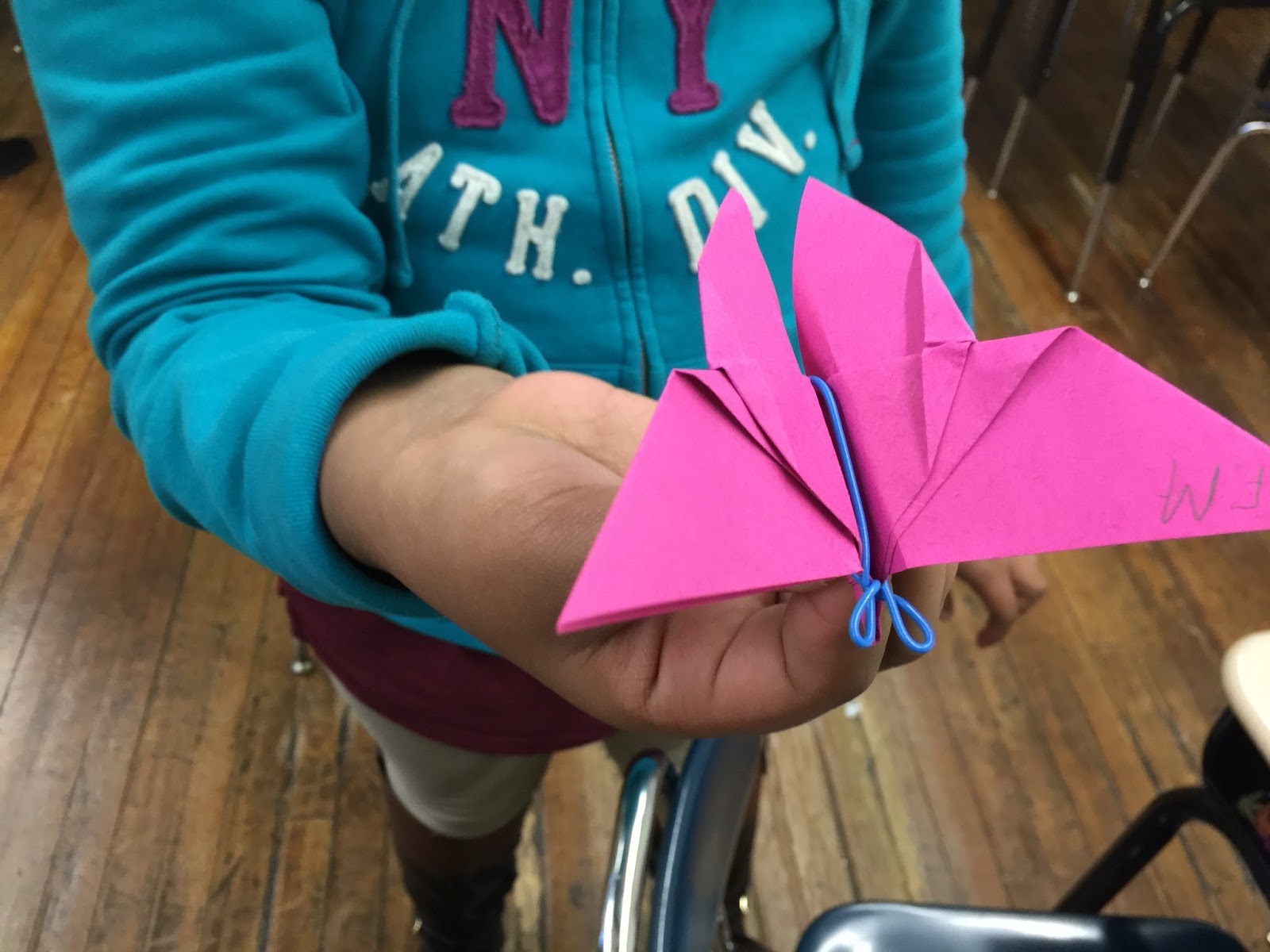
Meanwhile students in Mr. Anderson's fifth grade class were studying math by creating origami butterflies.  Students had to create symmetrical butterflies by carefully folding origami paper in eight steps.  Geometric patterns were created when the students opened up the folded squares of origami paper.  Students learned the math terms vertices and faces.  Students noted how many creases originated at the vertices.  


After the students made the butterflies they connected them with wire to form mobiles, which were brought to the main office for hanging.  

Origami is a great way to connect geometry and art.


In Ms. Tejada's third grade art class students learned about nine different artists.  Working in pairs, students prepared reports on artists in the "Getting to Know the Artist" book series, supplementing that information with research on the internet.  Each group presented their work to the class, at which time other students asked questions about the artist.  Thus all students were able to learn about all nine artists.  


The students then created paper cubes using a template provided by Ms. Sandler.  They measured the dimensions of the cubes, and then drew on each side, trying to recreate the style of their artists.  This included deciding upon materials, technique, and style.


Wednesday, June 22, 2016

Zentangles and Geometric Solids at School 29

Art teacher Ms. Elson’s fourth grade art class recently engaged in a mathematically driven project that incorporated two-dimensional zentangles in the background and three-dimensional geometric solids in the foreground.

In the background, a perspective of small to large curved forms, repeated in strong black and white patterns, generate the zentangles.  The effect is that the background sometimes appears to be moving.  In the foreground the geometric solids add excitement through contrast.  Each three-dimensional figure uses opposite colors - red & green, blue & orange, yellow & violet.
  The objectives of this lesson are:
            To articulate required knowledge concerning the elements and principles of art.
            To generate a project that is rooted in performance and product
            To engage in the study of aesthetics
            To utilize an application to produce a result.

 Another project took place in second grade teacher Ms. Taliercio’s second grade class.  With the assistance of Art PIR Professor Myra Winter, the classes created sculptures using four different-sized, opened shaped rectangular prisms.
 
Students were first given the measurements to create four different rectangles.  Then, through a series of carefully organized and coordinated folds, they created open rectangular prisms.  


The students then worked together in groups of four, using their imaginations to combine their prisms into sculptures.  Some of these were abstract, but some students created transformers or robots.

King Tut Part Three: The Finale!


King Tut, or the sculpture that began as part of an ancient Egypt study in Mrs. Marilyn Simon's STEAM art class, is now completed and a sophisticated and stunning work of visual art at SOIT.


As we blogged earlier (see this LINK and this LINK) King Tut emerged as a student-centered STEAM art project after Mrs. Simon's STEAM students created two-dimensional works of art while studying ancient Egypt. This sculptural project and creative process have proceeded with minimal assistance from SOIT Art Teacher Marilyn Simon and STEAM Art PIR Triada Samaras. In other words, these advanced STEAM art students at SOIT problem-solved together as an independent group to create this work of art.
 
Above images: King Tut in all his glory at SOIT
The completed King Tut sculpture makes an impressive addition to SOIT, 
where art teacher Marilyn Simon is determined the large-scale work will stay.  In celebration of this momentous  completion, Ms. Simon held a pizza party for her STEAM art students as well as for administrators and other teachers in the building.
Above:  STEAM Art Students at the celebration of the completion of King Tut at SOIT

Art Professor in Residence, Triada Samaras, recently traveled to North Carolina where she met Education Chief Michelle Harrell from the North Carolina Art Museum  As a result, Ms Harrell provided the STEAM students with some reference materials from the museum about art in ancient Egypt.  In the photograph above students are reading these materials with pleasure.
Above:  SOIT STEAM Art Students who worked together to create the work, with Professor Samaras (left) and Mrs. Marilyn Simon (right) 
Above:  SOIT Principal Vivian Gaines and Supervisor Hafiz Salim

In the photograph above, SOIT Principal Vivian Gaines and Supervisor Hafiz Salim browse through the materials on Ancient Egypt provided by Education Chief Michelle Harrell from the North Carolina Art Museum .  Professor Samaras and Ms. Herrell are already beginning to brainstorm a possible collaboration between the North Carolina Art Museum and the Gerladine R. Dodge funded STEAM program in Paterson.  Stay tuned for for next year!


Monday, June 20, 2016

Collaborative STEAM Art Quilt at NRC


As we mentioned earlier (see LINK) a collaborative STEAM Art Quilt has been in the works at New Roberto Clemente School/NRC for several months now.  

In STEAM meetings held twice per month at NRC with WPU STEAM Art PIR Triada Samaras, classroom teachers decided that each quilt square would communicate something about their classroom subject. 
Students were asked in each classroom to come up with thumbnail sketches for a potential design.
 
Using the democratic process in each classroom, the students voted for their favorite design and then figured out how to make an art collaboration on one quilt square possible. 


Many art materials were provided by Ms. Triada Samaras via the Geraldine R. Dodge STEAM grantThus teachers and students were able to select from among a wide range of materials to create their final designs.  Moreover, the quilt project provided a way for the students to de-stress during the PARCC Assessment weeks while reflecting on their learning for the year.

Art teachers Ms. Roche and Ms. Aramayo provided support for the classroom teachers.  They acted as consultants and answered questions the teachers had about design, composition and material use.  Below is Ms. Roche's demonstration for paper folding that she showed to the classroom teachers.  Classroom teachers were urged to "think outside the box" with the art materials and with their students. 
Technology teacher Janette Selino suggested the quilt squares be entered into a school-wide competition for a prize.  When the quilt squares from "Phase One" of this project were completed, they were all placed on display in the library.  Art PIR Triada Samaras facilitated teacher voting for the "best" quilt square.  Voting was very difficult due to the fact that so many beautiful quilt designs were created!  Finally a winner was chosen:  Ms. Cruz's Science Class and students won the contest! These thrilled students were awarded a pizza party. (See winning quilt square, marked with letter "L" on right.)


(Above:  from left to right Ms. Aramayo, Ms. Samaras, Ms. Roche, Ms. Selino)
 Next, Ms Selino, Art Teachers Ms. Aramayo and Ms. Roche, and Art PIR Triada Samaras installed the finished quilt squares in the school cafeteria.  This eating area now looks greatly enhanced with the addition of 13 new quilt squares.
Now that "Phase One" is complete and installed, "Phase Two" of this STEAM project can begin at NRC.  More beautiful quilt squares to come in the future!  Art PIR Samaras is hoping ALL NRC classes will eventually create a quilt square.
 Previous Blog Post on the NRC Steam Quilt:  LINK

Look for more quilt squares to come!