Monday, April 3, 2017

Permanent STEAM Art and the Pirate Pit Crew at NRC

Recently at NRC, Art Teacher Mandal's students have been thinking about how to create permanent STEAM art installations for their school building. This idea has been inspired partly by the Peace for Paterson Project that they placed throughout the building earlier this year.  The latest student installation is an innovative combination of construction materials and paint.   
First, Ms. Mandal asked the students to envision paintings for the ceiling using the existing white tiles as "blank canvases".  Thanks to the new NRC custodian, Mike, students were able to acquire a number of these tiles for their classroom where they set out designing their compositions,  Ms. Mandal urged them to think about inspirational slogans and images from visual culture and recent art history.  "What would you like to see on the ceiling of your school hallway?" she inquired.


Ms. Mandal then taught students how to mix and apply colors using acrylic paints to their compositions on their ceiling tiles.  

Students worked collaboratively both designing and painting the tiles.
When the tiles were finished, Mike was on-hand for the ceiling tile installation.  Ms. Mandal and her students directed him where to place these colorful and visually animated artworks.  
The result is a an awesome combination of engineering, science, and art that is now beautifying the NRC building in the public space between Principal Montez' office and the NRC library.  

Ms. Mandal and her STEAM Art students were thrilled to see these impressive results!  Furthermore, as this blog post is being written, more tiles are being installed.....Stay tuned!


In the meantime, NRC Physical Education Teacher Mr. Bonadonna is continuing a fascinating STEAM project using art to help teach his small engine repair class. Named the Pirate Pit Crew this class meets Monday thru Friday 3:20 PM to 4:00 PM in the gym.  Roughly twelve students from grades 6-8 regularly attend to work hands-on with small engines.

Each day students learn how to identify and trouble shoot engines that are not running properly. Once the diagnosis has been complete, the necessary repairs begin. Last year Mr. Bonadonna and his "Pirate Pit Crew" began discovering how color (an element of art) could help identify engine parts.  "Color coding helps students to organize their thinking," Bonadonna explained recently to STEAM Art Professor in Residence, Triada Samaras.  "Students can use color coding to help them troubleshoot and problem solve," he continued.

In addition, by using color, students can distinguish between the different components of an engine.  Bonadonna has also devised a method so that students can identify, for example, the variety of nuts and bolts that belong with a carburetor, a cylinder, a muffler, etc.  
In a recent project, students learned to repair a small engine because the power hose was clogged with the wrong type of fuel:  "Mud!"  They experimented until they could understand what was wrong, and corrected the problem. They also observed how the manufacturer used color to code the buttons for the user!

In another project, students learned how to save the valuable parts of a broken bicycle to use for another time.
In a variety of ways, students in the "Pirate Pit Crew" learn about science, math, technology, engineering and art (STEAM) seamlessly.  In addition they learn the valuable skill of salvaging and re-using and/or recycling what others might pass off as 'trash'.
It is no wonder Mr. Bonadonna is such a popular STEAM teacher! 
 

Monday, March 20, 2017

Figure Sculpture and Drawing at School 7


Under the direction of Art Teacher Ibrahem, students at School 7 have created artworks that use as their basis the work of significant artists, but that express the students’ own creativity and imagination.

Ms. Ibrahem 's fifth grade students studied the work of George Segal, whose work uses sculptures that employ the use of plaster bandages as a medium.  The students created statues of themselves by using rolled newspaper to form shapes that were then fastened together with masking tape.  They then applied plaster bandage.

Once the plaster was set, they painted the figures.  To get the correct proportions, they had to apply their science knowledge of the human body.


At the same time the sixth grade students incorporated into their work the study of kinetic energy, activity, gestures and body language by studying the work of Keith Haring.  Each student created a figure making a gesture representing who they are.  They then added emojis to complete the figures, and to further reflect their personalities.  All the figures were then placed upon the letters A R T. 
The completed work, which gives a sense of movement, vitality, and excitement, is on display at the All Paterson StudentArt Exhibition at the Paterson Museum.  
Ms. Ibrahem’s seventh grade students created self-portraits using the grid technique developed by artist Chuck Close.  This technique incorporates math concepts of ratio and proportion, and allows student to generate large artworks from small photographs, while still maintaining important small details.
The creative artworks described above are thus an exciting combination of art history, science, math, and imagination.

Saturday, March 18, 2017

GOPA, CAHTS, and SOIT continue to content-integrate and innovate using STEAM!


Art teachers and their students in three Paterson, NJ public high schools, the School of Government and Public Administration/GOPA, the  School of Information Technology/SOIT, and the School of Culinary Arts,  Hospitality and Tourism/CAHTS continue to content-integrate and innovate using STEAM! As a result new, interdisciplinary art lessons are dominating these programs with support from the Geraldine R. Dodge Foundation and WPU STEAM Art PIR Triada Samaras.  Three of these projects are featured below

In the School of Culinary Arts, Hospitality, and Tourism, Art Teacher Vivian Reyes developed a two-point perspective, still-life painting project with her STEAM students. This project combined math and art. Students were first asked to draw a still-life from observation, using two-point, linear perspective, a technique developed in the early Renaissance by Filippo Brunelleschi.


They learned: "The three components essential to the linear perspective system are orthogonals, the horizon line, and a vanishing point. So as to appear farther from the viewer, objects in the compositions are rendered increasingly smaller as they near the vanishing point. Early examples of Brunelleschi’s system can be seen in Donatello’s relief St. George Killing the Dragon (c. 1416–17)"


The next part of this lesson utilized knowledge from science, i.e. color theory. Students learned how colors are mixed using acrylic paint and an extender that keeps this fast-drying paint wet longer.  They also experimented with mixing a variety of color types including complementary colors, analogous colors, and tertiary colors.  Students learned how difficult it can be to create an excellent still life painting from visual observation.  But they were thrilled with their results!

In the School of Government and Public Administration, Art Teacher Darryl Jones created a human figure STEAM project that combined math and art. In the first part of this project, STEAM students learned to create a variety of geometric solids using plasticine clay. 
 
These forms included: the sphere, the cylinder, the rectangular prism, and the triangular prism. These are 3-D forms that students also encounter in their daily math classes, especially in geometry. Mr. Jones explained how often mathematics and the visual arts form intersections using examples from this link.  When students could execute these forms with confidence, Mr. Jones asked them to combine the forms to construct a human form and to give that human form an action. 

Students could choose any type of movement they wanted for their sculptures.  However, Mr. Jones stressed the need for them to all have actual, life-like proportions.  He explained how human proportions also relate to mathematics.   For example Leonard DaVinci studied these proportions in great detail and sketched them in his notebooks. (See his sketch of human proportions below.) 

Mr. Jones placed a photograph of a figure he created himself on the computer monitor as a prompt or inspiration for the students (see image below).
Students successfully created dynamic human form sculptures with their plasticine clay that withstood the ultimate physical test:  standing up, unassisted. They also photographed and drew these sculptures with pencil and paper, thus extending this art work into other media.
The resulting figures were full of life and motion! 


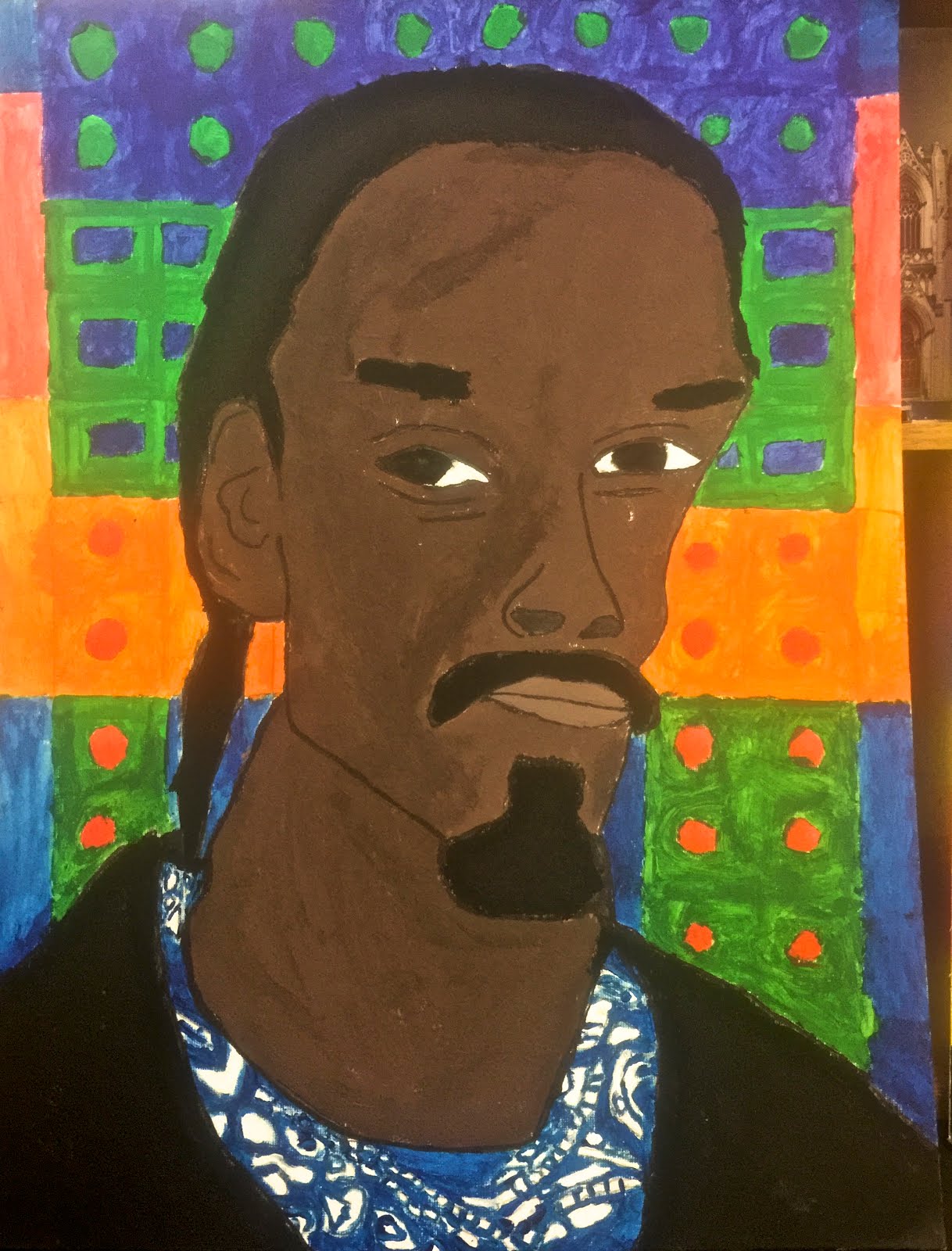
At the School of Information Technology Art Teacher Marilyn Simon created a grid portrait drawing/painting project that used the contemporary artist Chuck Close as a point of departure. 
This STEAM project used math, art and technology.  First students learned about the grid technique of Chuck Close on Youtube.  Chuck Close, who has numerous physical disabilities, developed this method to help himself "create 3-D space" in two-dimensions. Students were inspired by his story (see video below).
Next students chose a portrait to draw using this grid method. Students could choose to do either a portrait of themselves, or a portrait of someone famous.
Many opted for the latter.
Next students used tempera paint on canvas boards to bring these drawings to life. With the difficult part of the project over (the grid drawing part), students were happy to use invented colors and patterns to complete their portraits.  The results were a surprise for students and teacher alike!