Monday, April 18, 2016

School 7 Seventh Grade Students Consider How to “Nurture Nature”

On March 31st, seventh grade students from Paterson School 7 spent the day at William Paterson University's Ben Shahn Art Galleries engaging in activities that integrated art and science.  They were accompanied by Science Teacher Marla Arrington, Student Teacher and Woodrow Wilson Fellow Sue DeNardo, Art Teacher Vernon Nealy, ScienceTeacher Tracy Pearson, Art PIR Myra Winter, and Geraldine R. Dodge Grant Coordinator Dina Scacchetti.

The day began with a tour of the current exhibition, Living Together: Nurturing Nature in the Built Environment.  This exhibition features living plants as well as photography, drawing, and collage, and addresses, “our complex, mediated, and often fraught relationship with the natural world.”  The exhibition ties in perfectly with a project-based learning effort that the seventh graders are engaged in:  the development of a sustainable village ecosystem, in which criteria such as food/water sources, energy sources, waste disposal/decomposition systems, habitat conservation, and architecture all have to be ecologically sound.  In the pictures below Director of University Galleries Kristen Evangelista leads the discussion about the exhibition.

In the picture at the right students interact with a “beanbag” chair created from recycled materials that mimic artifacts of nature.


After seeing the exhibition, the students adjourned to a classroom where Adjunct Professor Gina Miccinili, Gallery Manager Emily Johnsen, and Gallery Interns Kristina Sternesky and Mitchel Sybesma led the students in an art activity.  Each student was supplied with a terracotta flowerpot, and access to acrylic paints of various colors.  They were invited to paint the pots in individual and creative ways.  Some students’ work was very representational, while others developed abstract designs.

                
While the paint on the pots was drying, students toured the   College of Science and Health’s greenhouse, in which different rooms mimic different ecosystems.  Professor Michael Wyrwa showed students plants that have adapted to different environments in various ways.  For example cactus plants have adapted to desert environments by reducing their water loss.  Certain plants that grow in poor soil have developed means to “capture” insects and “digest” them to obtain needed nutrients.

The students also viewed some of the campus sculptures with Ms. Evangelista. In the process they identified and reviewed math vocabulary and concepts that were used in the creation of these artworks


Next, students returned to the classrooms, where the gallery interns gave a brief lesson on seed germination. 
 
The students then found their individual pots, filled them with potting soil, and planted seedlings of herbs, e.g. dill and/or basil.  They were provided with instructions on how to “nurture” their plant.


At the end of this highly productive and fascinating day, each student left with a painted pot in which a seedling had been planted.  Let’s hope they grow! Transportation for the trip was provided through William Paterson University’s Geraldine R. Dodge Foundation Grant.

Monday, March 14, 2016

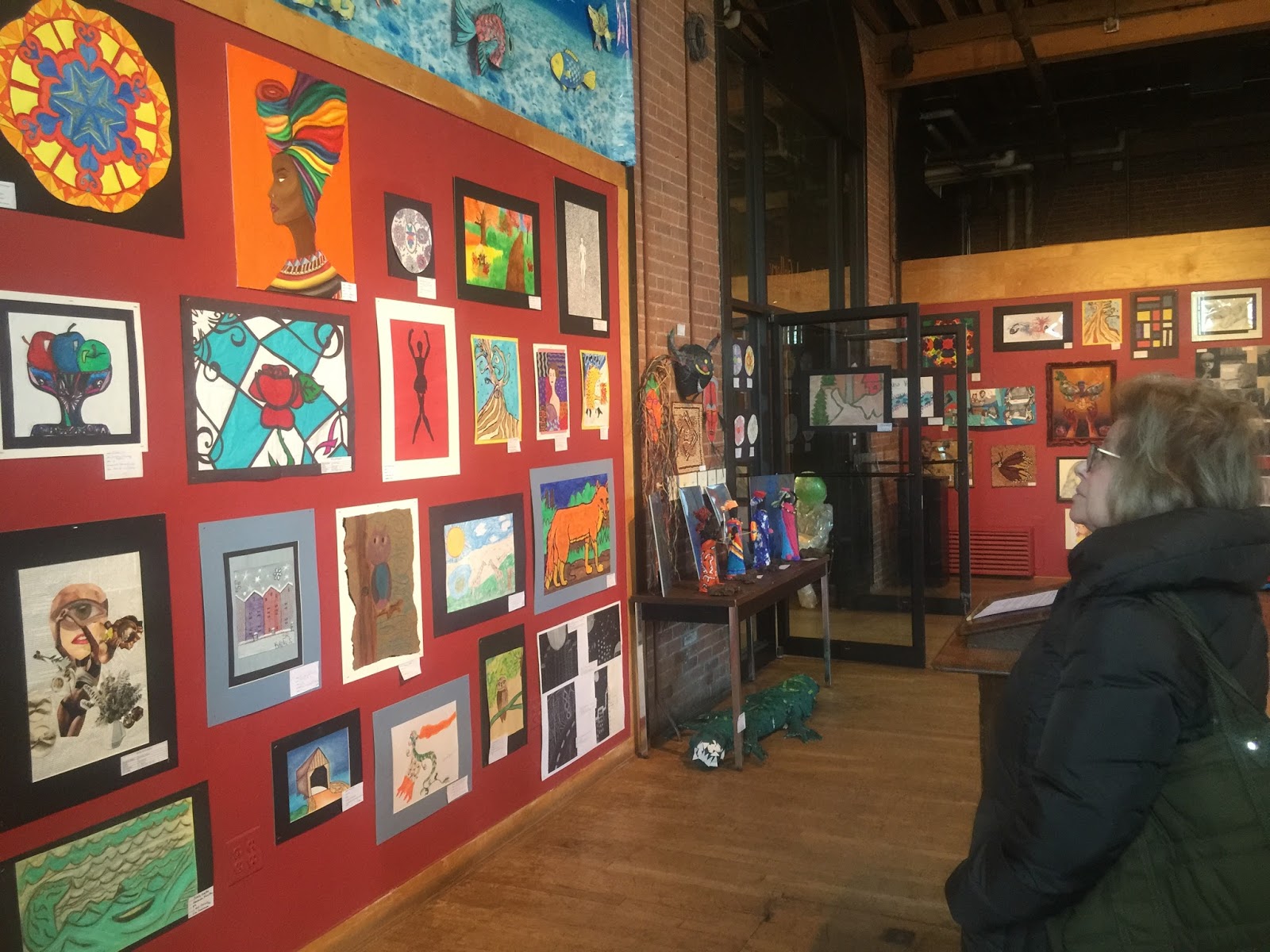
Gala Reception held at Paterson Museum for the All Paterson Student Art and STEAM Art Exhibition!


On March 7, 2016, the Gala Reception for the All Paterson Student Art and STEAM Art Exhibition was held at the Paterson Museum at 2 Market Street in Paterson, NJ.  Students, teachers, families, administrators, and WP PIR's were all in attendance for this fabulous event which was catered by students attending the School of Culinary Arts, Hospitality, and Tourism.


Co-curator of the exhibition and SOIT Art Instructor, Marilyn Simon, formally opened the exhibition. (See image below)
A wide variety of excellent artworks in all media were on display at the Paterson Museum including drawings, collages, paintings, and sculpture.  In the center of the exhibition was a STEAM collaborative paper sculpture entitled "Racimo of Reflection," which was created by teachers in many different disciplines at the New Roberto Clemente School under the direction of (STEAM) Art PIR Triada Samaras. This sculpture was done under the auspices of the Geraldine R. Dodge Foundation STEAM grant. In the image below Art PIR Triada Samaras stands near "Racimo of Reflection."
At the entrance of the exhibition was a video of all the art teachers in Paterson commenting on their roles as art instructors in this lively and imaginative district.  In the image below, GOPA Art Instructor Darryl Jones can be seen speaking on the video.
Overall this gala reception proved to be an inspiring and successful event for the 


Left: (from left to right):  GOPA Art Instructor Darryl Jones, Art WPU Professor in Residence Triada Samaras, Dodge Grant Manager Dina Scacchetti, and art student.
Above:   Supervisor of Business, Technology, and Art Hafiz Salim observes student art works.  
Below right:  Dodge Grant Manager Dina Scacchetti speaks with Paterson School 29 Art Teacher JeriAnn Elson and exhibition viewer.
Above:  NRC Assistant Principal Romaine Royal and WPU Art PIR Triada Samaras.  
Below:  CAHTS Art Instructor Vivian Reyes and her students near their artworks.
Below WPU (STEAM) Art PIR Myra Winters views student artworks.

 The exhibition will be on display during normal museum hours until March 31, 2016


Saturday, March 12, 2016

School 2 Sixth Graders study "Ebb and Flow" and "Trace Time"

On March 1st, sixth grade students from School 2 traveled to William Paterson University for a full day of art, science and math.  The day began at the Ben Shahn Art Galleries, where students visited the current exhibitions.  Director of WP University Galleries Kristen Evangelista, pictured below, led the students through the exhibition “Tai Hwa Goh:  Ebb and Flow,” in which New Jersey-based artist Tai Hwa Goh used printmaking and hand-waxing techniques to create “a site-specific installation that resembles landscapes and biological forms.” 

Gallery Manager Emily Johnson, at left, guided the students through the exhibition “Traces of Time:  Photographic Exploration of the Natural World,” which featured the work of four photographers who “utilize scientific research, conduct experimental studies, or embark on expeditions to capture the passage of time through changing landscapes, organic life cycles, or celestial activity.”


Dr. Martin Becker, Professor of Environmental Science, gave a presentation on fossils.  Students heard about, saw, and handled real fossils that had been found on the WP campus. 


  Led by Art PIR Simone Sandler, the students 
then engaged in an activity in which they made their own simulated "fossils" using modeling clay and plaster.  They used the paleontological vocabulary that Dr. Becker had taught, distinguishing between the terms cast and mold.  These terms are also the vocabulary of sculpture.  Below left Ms. Sandler explained to students how to make their fossils.  

 
The picture at the left shows the students' fossils drying; at the right are examples of the finished products.


Professor Michael Wyrwa took the students on a tour of the College of Science and Health’s greenhouse, in which different rooms mimic different ecosystems.  They heard about a beachgrass experiment.  Beachgrass is a stabilizer of sand dunes, and the New Jersey shoreline that suffered damage by Hurricane Sandy might benefit from beachgrass-stabilized dunes.


The students then viewed some of the campus sculptures with Ms. Evangelista, in the process identifying and reviewing math vocabulary and concepts that were used in the creation of the artworks.

After lunch at Ben Shahn, the students walked to Shea Performing Arts Center.  They attended the Midday Artist Series:  Student Recital, which featured performances by WP Music Education students.

Transportation for the trip was provided through WP’s Geraldine R. Dodge Foundation Grant.

Wednesday, February 24, 2016

Firing on all Cylinders: Pirate Pit Crew at NRC with Mr. Bonadonna

                  Above:  Mr. Bonadonna, Physical Education Teacher at NRC 
teaching students about a lawn motor engine

As part of the NRC Enrichment Program, Mr. Bonadonna, Physical Education teacher at NRC, holds a small engine repair class daily for students grades 6-8.

Named the Pirate Pit Crew this class meets Monday thru Friday 3:20 PM to 4:00 PM in the gym.  Twelve students from grades 6-8 regularly attend to work hands-on with small engines.  Mr. Bonadonna sends out an email to teachers searching for small engines in need of repair and run by gasoline. Teachers with these non-operating engines happily bring them to the Pirate Pit Crew.

An NRC student looks the piston and asks Mr. Bonadonna 
question about its condition

These engine types include Honda, Briggs and Stratton, and Tecumseh and can be found in lawnmowers, weed trimmers and snowblowers for example.  Each day students learn how to identify and trouble shoot engines that are not running properly. Once the diagnosis has been complete, the necessary repairs begin. 

 Here, students in Mr. Bonadonna's class have removed the cylinder head and are examining 
the valves while Dodge STEAM grant manager, Dina Scacchetti, lends a helping hand

Recently, Mr. Bonadonna joined the STEAM Team at NRC, where he met Art PIR Triada Samaras and he became aware of the fact that color could enhance his class.

Here, students in Mr. Bonadonna's class are removing a gas tank while 
Dodge STEAM grant manager, Dina Scacchetti, observes

Mr. Bonadonna sees the opportunity of using color (an element of Art) in his class to help students distinguish between the different components of an engine.  He plans to create a color coding method so that students can identify, for example, the variety of nuts and bolts that belong with a carburetor, a cylinder, a muffler, etc.  In this class students also need to use math skills.  They must be able to differentiate between standard and metric tools, and ratios for gas and oil mixtures. In addition, students must use technology to research the engines since manuals are not available. Thus, Mr. Bonadonna's small engine repair class embraces cross curricular content areas incorporating science, technology, engineering, art and math and is the ultimate STEAM class!

Here, Mr. Bonadonna's students are dismantling a carburetor

Mr. Bonadonna explains, "Students love this class because it gives them a sense of accomplishment and instant gratification.  Our turn-around is usually one week from broken engine to a fine running machine that is ready to be put to use.  Students are very excited to return these machines back to their owners and have sense of achievement. It is a "win-win" situation for everyone: for the student, the owner of the machine and myself as an instructor."

Here, Mr. Bonadonna's students are discussing the finals steps of reassembly.


Sunday, February 21, 2016

Patterns and Post Its at School 7

Human beings have observed patterns throughout their existence.  They have expressed these patterns in numerous ways, one of which is weaving textiles.  The ancient art of weaving can be traced back about 12,000 years.

Many people consider mathematics to be the science of patterns.  British mathematician G.H. Hardy in his book
A Mathematician’s Apology, wrote, “A mathematician, like a painter or a poet, is a maker of patterns.  If his patterns are more permanent than theirs, it is because they are made with ideas.”


In a project carried out in Art Teacher Nealy’s classroom, with the assistance of Art PIR Myra Winter, students at School 7 first designed unique patterns, and then wove textiles of colored yarns that expressed those patterns.  In the process they learned how warp and weft threads can be used to create a symmetrical and colorful mini-tapestry.


This project combined the concepts of mathematical and physical patterns through the creation of woven artworks.


Ms. Bertino’s 6th grade Science class was studying the unit of biology that deals with the driving question “How can one explain the ways cells contribute to the function of living organisms?”  They needed to learn that the essential functions of cells are carried out by internal cell structures called organelles.

To help her students learn and retain the crucial information, she designed a lesson in which they created “Post It Cells” that modeled the structure and function of the various cell parts, and ways the parts contribute to the overall function. 

The students then “posted” their finished products on a bulletin board for all to share.


Friday, February 19, 2016

Dodge STEAM Grant High School Students Attend Gala ARTstart Reception at William Paterson University!


On Saturday February 6, high school students from the three Dodge STEAM grant supported high schools:  GOPA/School of Government and Public Administration, SOIT/School of Information Technology, and CAHTS/School of Culinary Arts, Hospitality, and Tourism attended the Gala ARTstart Reception held at the Power Art Building at WP/William Paterson University.  High School art students from these three Paterson schools together with their art Instructors joined students and instructors from all over Northern New Jersey to participate in this annual event organized by Professor Uhlein of the WP Art Department

In attendance from the three high schools were students' families, friends, their art instructors Darryl Jones (GOPA), Vivian Reyes (CAHTS) and Marilyn Simon (SOIT), STEAM Grant Coordinator, Dina Scacchetti, and Art PIR Triada Samaras.  Senior art students who had work in the exhibition could bring their portfolios for review prior to the start of the reception to be considered for a potential art talent scholarship to WP

 Above:  Dodge Grant Coordinator Dina Scacchetti holds WP certificates for participating GOPA. SOIT, and CAHTS art students.  More than 100 people attended the opening, which was clearly a family affair.

 
Above:  CAHTS Art Instructor Vivian Reyes stands with her students' and her own art work at ARTstart.

Above:  SOIT Art Instructor Marilyn Simon stands with her students' and her own art work at ARTstart.


At leftGOPA Art Instructor Darryl Jones stands with his students' and his own art work at ARTstart.


Above:  WP Student Art Teacher Ashley Zampino stands with her student Alejandro Garcia (SOIT) and his art work at ARTstart.


Above:  GOPA Art Student Ashley Zumba stands with her father in front of her Analogous Color Painting created with marker on paper.

 Above:  CAHTS Art Student Tiffany Rivera stands in front of her "Tiger" drawing created with India ink on paper and her four black and white photographs.

 
Above:  GOPA Art Student Art Eucarys Vizcaino stands in front of her Radial Symmetry Drawing created with marker on paper.