Monday, June 19, 2017

The STEAM Learning Quilt project is back this year at NRC!

While the intense PARCC testing took place at NRC this spring, an all NRC STEAM art project begun last year continued to expand into its second year, allowing teachers and students some much needed creativity and flexibility after the rigors of the daily PARCC testing. 
Above NRC teachers gaze at the Learning Board Squares created this year at NRC during PARCC testing and vote for their favorite one. Ms. Gencarelli's class won first prize
Called the "Steam Quilt" last year, this project was re-named the "Steam Learning Board Quilt" this year.  The original idea for this project (created by NRC content area teachers last year during weekly STEAM and arts integration meetings) was for students to try to envision their content areas visually and to create a corresponding visual art work. Teachers felt that this project would facilitate students using the highest level thinking skills from Bloom's Taxonomy: synthesis and evaluation. And indeed it did.

 Above:  Students from Ms. Cruz's Science class created this square to depict their interpretation of mathematics

Each "Steam Learning Board Square" is therefore a visual depiction of the subject (by students) of the content area taught in their classroom, eg math or social studies or language arts.  
 Above:  Students from Ms. Munem's Social Studies class created this square to depict their interpretation of world religions

Interested teachers received art supplies and assistance from WPU Geraldine R. Dodge funded STEAM Art Professor in Residence Triada Samaras who urged these teachers to ask their students to brainstorm and create collaboratively and independently.


     Above:  Students from Ms. Gencarelli's Math Studies class created this square to depict their interpretation of mathematics

Professor Samaras deliberately left this project "open-ended" and encouraged the participating teachers to allow their students to brainstorm, problem-solve, and collaborate on its creation. (See more on this below).  This was a welcome arts integration project for teachers and students in the afternoons following the rigorous and highly structured PARCC testing held in the mornings.
Above:  Students from Ms. Selino's Technology Class created this square to depict their interpretation of their class Mets trip using technology

Above:  Students from Ms. Diaz's Algebra class created this square to depict their interpretation of mathematics

Above:  Students from Ms. Cruz's Science class created this square to depict their interpretation of science

One teacher, NRC Math teacher Ms Pritchard, documented her students in the process of creating their mathematics learning board (pictured below).  She explained to Professor Samaras that in fact these students were highly vested in their project and were not happy with their first attempt at creating a board. They decided to make a second attempt after the first one did not meet their expectations. 

Above Ms Pritchard's students were NOT happy with their first orange colored learning board (below) and insisted on creating a second, final one.


Ms. Pritchard sent Professor Samaras an email explaining: 

"Attached is a picture of the first project that my students completed and two pictures of them working on the new one.  I asked my Steam Team why they wanted to redo their project and these are there responses.

Ms Pritchard: Q: What were you unhappy about with the first board that was created?
  1. Kayley: "I didn't like the format.  Things weren't spread out correctly and I didn't like the color combination."
  2. Sumaya:  "It was too busy and the colors didn't go together"
  3. Mariely: "It was unorganized"
  4. Dayana: "Too busy"
Mrs. Pritchard replied back to them:  "I don't think the spacing was right.  The content was too close together so it was hard to see which numbers and letters were part of which math topic."
The students agreed. Below is their second learning board with the students' self-selected modifications.  After this board was completed it was obvious to these math students that their problem solving skills could apply to not only mathematics but to art and design!
 Above:  Ms. Pritchard's students created this second learning board

Professor Samaras pointed out to Ms. Pritchard and her students one of the "Ten Lessons the Arts Teach by the late Professor Eliot Eisner:

"The arts teach children that in complex forms of problem solving purposes are seldom fixed, but change with circumstance and opportunity. Learning in the arts requires the ABILITY and a WILLINGNESS to surrender to the unanticipated possibilities of the work as it unfolds." (Eisner)
Next to come:  These new learning boards will be installed in the NRC cafeteria where they will become permanent fixtures on the walls for the NRC community to enjoy! Stay tuned!...


Saturday, June 17, 2017

Following Up On Two Permanent STEAM Art Projects at NRC

Two on-going permanent STEAM art projects have changed the face of the NRC building in dramatic and positive ways!  First of all, Ms. Mandal's ceiling tile project has continued to fascinate the student artists who are in grades 6-8 in her art classes.  


Ms. Mandal asked the students to envision paintings for the ceiling using the existing white ceiling (acoustic) tiles as "blank canvases".  
She urged them to think about inspirational slogans and images from visual culture and recent art history for their art work.  "What would you like to see on the ceiling of your school hallway?" she inquired.  Students were inspired to leave a piece of themselves "behind" in their school, something that would even last beyond their graduation.
An increasing number of tiles have been added weekly to the ceilings of the NRC building by Mike the custodian who also has been providing the blank acoustic tiles.
The artworks painted onto the tiles reflect a great deal about the ideas, preferences, choices, and aesthetics of the middle school students at NRC and their words and images now adorn the school "speaking" to the viewer or passerby from "above."  The result is an awesome STEAM art project: a combination of engineering, science, art and the many voices of middle school students.


In a second, equally compelling project, NRC Physical Education teacher, Mr. Shikman, has worked with his after school classes in carpentry to carve and install the names of each of the NRC classrooms (named after prestigious universities) onto the gymnasium wall.  At NRC, each homeroom has the name of a major U.S. university.  The purpose is to keep students constantly aware of the goal of the school: that all students prepare for colleges and careers, and that they have the highest aspirations for their futures.

This student project combined art, math and science.  Students used measuring tools, drawing tools, chiseling tools, painting tools and more. The unusual art supplies (tools lumber, paint, and epoxy) were used with caution in Mr. Shikiman's after-school carpentry class as part of NRC's extended day program.  NRC students beamed with pride at their new carpentry tools and their handy work.


The finished art works look so professional it is hard to believe middle school students created these plaques!  Once again this permanent STEAM art collaboration will be enjoyed by students, teachers, administrators and families in the NRC building for years to come!

 Right image:  NRC Physical Education teacher Mr. Shikman with one of his students


Paterson STEAM Art Students Awarded at WPU!


Above:  Ashley T., 6th grader with her trophy from Mr. Baldwin
Ashely was awarded by WPU in May
On Wednesday May 10, 2017, an opening reception and awards ceremony was held at WPU's College of Education honoring exceptional art work created in Professional Development Schools (PDS.)  A wide variety of excellent art works from all over the PDS network were submitted to the college.  From these, many exceptional art works received honors.
Above:  Egyptian Amulet Necklace by Ashley T., 6th grader who was awarded by WPU this week
One of the awards went to Ashley T., a 6th grader in Technology Teacher Howard Baldwin's class at NRC.  Ashley's stunning amulet necklace was created as a result of the innovative STEAM collaboration between NRC and the North Carolina Museum of Art. Directed by Geraldine R. Dodge STEAM Grant funded Art Professor in Residence, Triada Samaras, this collaboration brought together the Art Education Department from the North Carolina Museum of Art together and 5 teachers at NRC. Ashley's work is a testament to the passion and expertise brought to NRC during this collaboration, as well as to the technical expertise and encouragement of NRC's Mr. Baldwin.
 Above:  Dodge Science PIR and STEAM Grant Manager Dina Scacchetti proudly displays the three framed, student artworks submitted to WPU for consideration from NRC.  These 3D printed amulets projects came from the STEAM project collaboration between NRC and the North Carolina Museum of Art.

Also honored was Leslie Morales who is a STEAM art high school student in Ms. Vivian Reyes' STEAM class at CAHTS.  For this lesson, Ms. Reyes had her students explore the mathematics of one- and two-point perspective together with a still life study using acrylic paint.  Students learned about the geometry inherent in all natural forms as well as the use of perspective in art to create the illusion of deep space on a flat surface. In addition, in order to create the realistic colors used for these still life artworks, students studied and applied the science of color theory to their projects.  This painstaking process produced stunning and naturalistic results!
 Above:  Still Life painting by Leslie Morales
All awarded students receive beautiful certificates from the College of Education and their art works become part of the permanent collection of student art works in the WPU Education Department, inspiring pre-service teachers and many others for years to come.  Congratulations to all the winners!

Thursday, May 18, 2017

School 29 Follow-Up to Meadowlands Field Trip


Upon returning to school after their field trip to the Meadowlands Environmental Center on April 24th, second grade students in Ms. Forchette's class worked collaboratively to create the beautiful bulletin board that now brightens up the first floor hallway near the entrance to the school.  
The bulletin board displays some of the insects (and "non-insects") that the students observed and learned about on the field trip, including ladybugs, ants, and pill bugs.

Wednesday, May 10, 2017

WPU Practicum Teacher Creates Two Excellent STEAM Lessons for High School

Recently WPU Practicum Student Katherine Machere created two fascinating as well as rigorous STEAM art lessons in her WPU practicum placement with high school students at SOIT in Paterson, NJ.  
Ms. Machere is a pre-service art education student at WPU, as well as a fine arts major with a sculpture concentration. Her expertise in sculpture-making using plaster bandages greatly facilitated her ability to teach these lessons with great success. 

Ms. Machere is also currently enrolled in Professor Triada Samaras' "Art Methods for K-12 Teaching" course at WPU.  This course teaches pre-service K-12 art teachers how to create and implement lesson plans for the classroom. In this course Professor Samaras, who is also a WPU STEAM Art Professor in Residence at SOIT, emphasizes the creation of STEAM art and arts integration lessons. Thus Ms. Machere made a seamless transition to a Geraldine R. Dodge funded STEAM school in Paterson. In these schools, arts integration into other content areas such as math and science is a natural occurrence, yet neither the creativity and/or self-expression of art-making are lost for the students. In addition, Ms. Machere and Ms. Samaras have spent many afternoons together in the classroom at SOIT brainstorming with art teacher, Marilyn Simon, a long term veteran at SOIT and an expert art teacher.  Machere's lesson plans grew out of this general context.  Her first lesson, hand sculpture, featured a blend of art, science, and engineering and was inspired by the ideas of autobiography and identity.  
In this lesson Ms. Machere initially asked the students, "How might you be able to express an aspect of your autobiography without words but using only visual means?" SOIT high school students pondered this question and an ensuing discussion followed about individual identity and expression for these high schoolers. Next, Ms Machere presented visual images of hand gestures and students pondered the use of them as a visual communication and to express meaning.  Students examined the art work of artist, George Segal, who works with plaster bandages and uses a simple visual language to explore aspects of humanity.
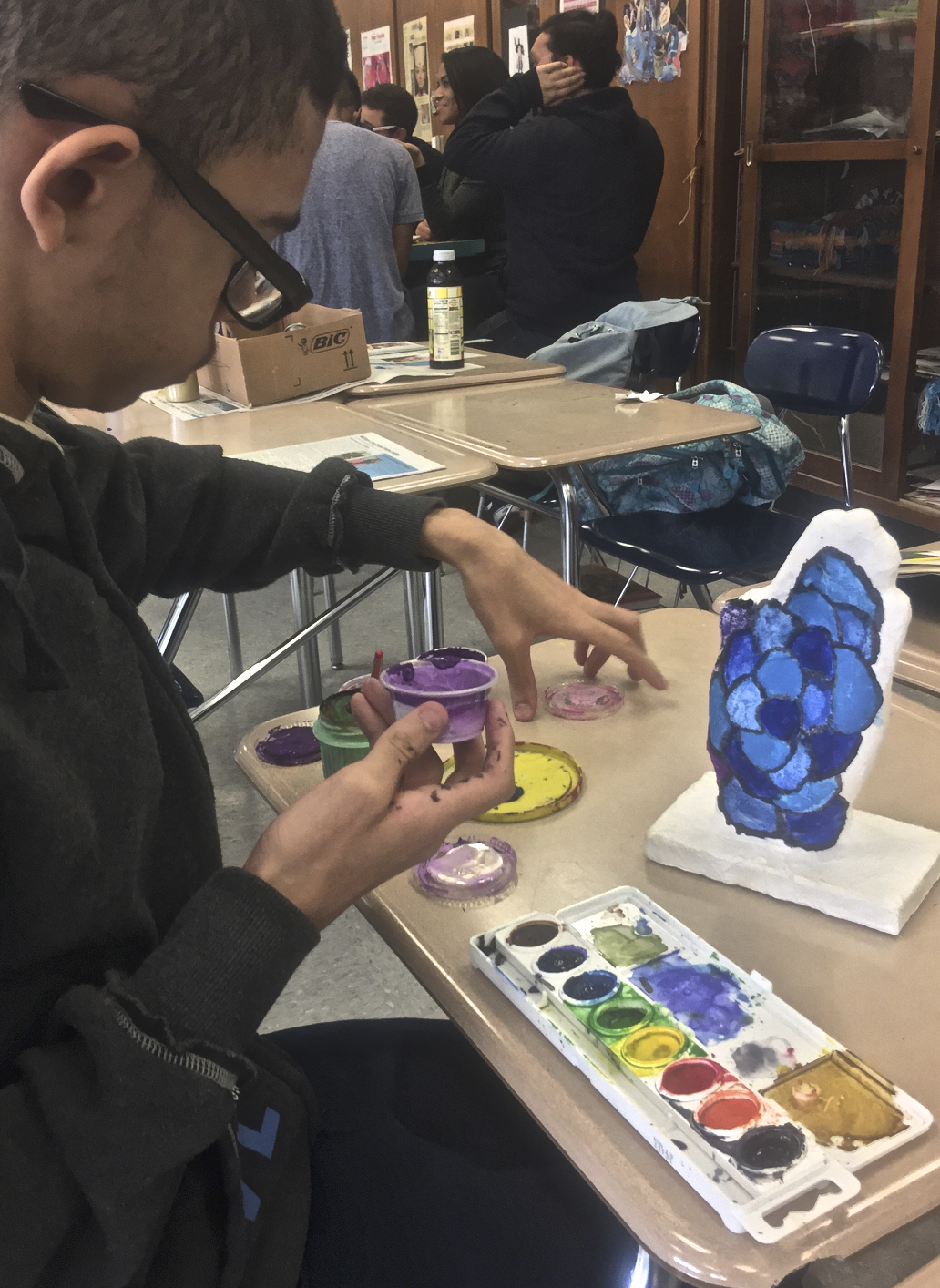
From this point, students were ready to brainstorm their own ideas for communicating with this medium.  Students selected a gesture they wished to represent.  Ms. Machere did a demo with the plaster bandages to explain how students could use this material to achieve their desired ends. Students worked in pairs with great enthusiasm, getting used to the engineering and science problems inherent in this art medium.  As the plaster medium only took 15 minutes to dry students had the satisfaction of seeing quick results!  After the hand sculptures were dry students sanded them and mounted them onto small blocks of wood Ms. Machere brought to the classroom.

Next, Ms. Machere asked the students, "What colors and/or textures could you use to further communicate your meaning to the viewer?" She urged students to "think outside the box" and to experiment with a wide variety of colors and painting techniques. She also encouraged them to use "mixed media" on their hand sculptures. Students relished the opportunity to paint and collage their plaster hand sculptures and a wide variety of solutions emerged.


This hand sculpture lesson was a true STEAM and arts integration one, with the high school students able to simultaneously increase their knowledge about art, science, engineering and meaning-making in this activity.

On another day in the SOIT classroom, Ms. Machere posed more intriguing questions to the high school SOIT art students: "What does a city look like visually? What are the visual forms shapes lines etc that help the viewer know they are looking at a city?" she asked them.  Students pondered and discussed the shapes, and forms inherent in the urban environment considering the math and engineering aspects of the city, as well as its physical characteristics.  Students brainstormed collaboratively to plan their structures for the city.  Ms. Machere demonstrated how to piece together recycling materials to create an armature for the plaster wrapping bandages.  In this lesson, she also gave them a time limit challenging their ability to create under a time constraint. Students were eager to use their newly acquired plaster bandage wrapping techniques and creative process on this new problem!  The results delighted them as well as Ms. Machere, Mrs. Simon, and Ms. Samaras!  This was another fine example of a STEAM lesson in the high school art classroom.


As a Fine Arts major with an emphasis in sculpture, Ms. Machere recently presented her final art works in the Power Arts Gallery at WPU for her Senior Thesis and BFA degree. Machere's work is a perfect example of a STEAM project, seamlessly integrating aspects of science, technology, engineering, art and math. In her written paper, Machere explains her fascination with sunflowers that led to her interest in the mathematical fibonacci sequence. Fibonacci numbers often appear unexpectedly in mathematics as well as science such as as sunflowers. Machere explains the "sunflower is unique because it is the only flower whose seeds grow in the fibonacci spiral formation".  This fascinating fact forms the basis of Machere's artistic explorations for her Senior Thesis.


Machere cites her WPU Practicum teaching experience at the School of Information Technology in Paterson, NJ, and her work with Professor Triada Samaras, Dodge funded STEAM PIR at Eastside, and Machere's K-12 Art Methods professor and supervisor at WPU, as inspirational to her work.  She describes how difficult it was for her to create the fiberglass molds for her large wall sculpture (see below) and how hard it was to figure out the correct electrical wiring for it so that the lights would slowly form into a fibonacci spiral.  Her use of scientific research and trial and error were key. She notes, "I find that I have done the most learning in my life by experimenting and finding that most problems in life do have more than one answer".  She links this learning process to the "10 Lessons the Arts Teach" by Dr. Elliot Eisner she learned about in Professor Samaras' Art Methods class. As a future K-12 art teacher, Machere states confidently that she will, "bring this same philosophy to my future art classroom". Bravo Ms. Machere!


Click the arrow above to see this remarkable Machere STEAM art sculpture "live"