Friday, May 24, 2019

William Paterson University 11th Annual PDS Conference

The 11th annual PDS Conference at William Paterson University was held on 
Thursday, May 23. The keynote speaker was Clint Pulver, "The Millennial Speaker" and musician who spoke about "The Power of One Multiplied" to the several hundred teachers and administrators from the WPU PDS Schools network.
Mr. Pulver stressed during his keynote speech and remarkable drum performance that,  “It’s not about being the best in the world…it's about being the best for the world."


Dr. Heejung An, Simone Sandler, Triada Samaras, and Patricia Kaminski conducted a workshop entitled, "Use of Music Integration Across the Curriculum to Cultivate Creative Thinking." during the afternoon session of the conference. This directly linked to the morning activity presented by Mr. Pulver, who handed out drums to the entire audience and led an audience based performance and experience.


In this workshop, the four presenters defined arts integration for the audience as interdisciplinary teaching practice through which non-arts and arts content is taught and assessed equitably in order to deepen students' understanding of both. (NJPSA & Dodge, 2017) Dr. An, used Poll Everywhere to discover the audience's connotations of the word creativity. Below are the visual results.


Afterwards, Simone Sandler discussed making handmade musical instruments. She covered using recyclable materials and natural objects in the construction process of the instruments. 


Above, WPU Art PIR Simone Sandler discusses arts integration utilizing instrument creation with teachers

After that, Arts Integration PIR Triada Samaras and Don Bosco Technical Academy art teacher Patty Kaminski presented "Arts Integration with Music and Science at Don Bosco". They explained to the audience how the project was accomplished in an interdisciplinary manor involving Ms. Kaminski, music teacher Mr. Hayden, and science teacher Ms. Post, with Ms. Samaras directing. 

Patty Kaminski, left, and Triada Samaras during their presentation

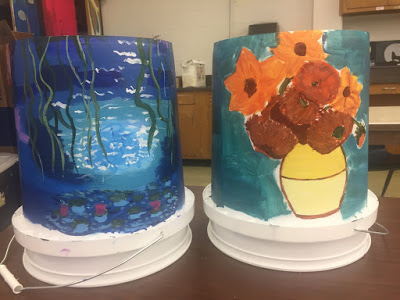
They engaged the audience, asking them to invent science/drumming activities for the classroom using the drums painted by Ms. Kaminski's students.


A full description of this arts integration lesson was completed at Don Bosco during the school year with a drumming performance for parents on Report Card Night. Please see this link for more details.


Ms. Kaminski and Ms. Samaras had a super day at the conference

Thursday, May 2, 2019

Arts Integration: Paterson School 12 Visits William Paterson University


On April 29, 2019, third graders from School #12, of the Paterson school district, went on a field trip to William Paterson University. They visited the Ben Shahn Gallery at WP and learned about the life and art of Cuban born painter Rafael Soriano (1920 -2015): LINK


The students discussed his early work, which consisted of geometric abstractions, or paintings featuring rectangles, triangles, squares, and circles. Then, they examined his different representations of the human head, which featured organic or natural shapes and luminous colors of red, orange, blue, purple. The students shared their reactions to the paintings’ imagery and colors and talked about how colors evoke different emotions.

The students also participated in a workshop conducted by teaching artist Deborah Guzman Meyer. They created a project which explored emotions evoked by different colors, while making portrait silhouettes of their inner selves. Students also learned about the “resists” technique, using oil-pastels and water color paints to create their artwork. The color psychology chart they learned about can be found at LINK


After lunch, the students visited the WP greenhouse and athletic field to get some exercise. What a great way to end the field trip!


Wednesday, May 1, 2019

Talking with Don Bosco Students about the Benefits of Arts Integration

Earlier this year two teachers from Don Bosco Technical Academy: Ms Patti Kaminsky, art teacher, and Ms. Jennifer Post, science teacher, created an arts integration science/art lesson for a class of sixth grade students on the topic of planets and the solar system.  Each teacher formulated separate learning objectives in this content area.  However, these objectives were simultaneously taught during the same lesson period.  LINK 
On Tuesday, April 30, Don Bosco Technical Academy 6th grade students had a chance to look back and to reflect upon their process of learning in the this arts integration lesson. 
Students spoke in detail about their learning and their experience in this Science/Art collaborative lesson, They had positive and favorable recollections 
about this lesson.
Above:  Ms Post writes the students' comments on the board.

Ms. Post, Ms. Kaminski, and WPU Art PIR Triada Samaras asked these students to reflect deeply upon, and to describe in detail, why they seemed to definitively prefer learning science content along with art content simultaneously.

Above:  Students work in groups during the art/science integration lesson.

Students offered a wide variety of insights and made the case for arts integration.
Their observations were thoughtful.  Among these were:  

The integration of the science and art lesson:
  1. Gives them a physical picture of things they are learning.
  2. Enables them t see how the science content is designed by imagining it in their minds.
  3. Helps them see and understand the subject.
  4. Enables them to work and learn together and brainstorm in groups.
  5. Helps them enjoy learning science more.
  6. "I could not enjoy myself so much in science if it did not have art too."

ART PIR Triada Samaras asked the two teachers whether they had each achieved their learning objectives for this collaborative lesson?  Each one agreed they had not only met their learning goals, but had exceeded them.  They would like to continue collaborating in the future as well.


Friday, April 26, 2019

Arts Integration: Arts, Math, and Language Arts at School 9

This project is an arts integrated lesson created 
recently at Paterson School 9.
2nd grade students were studying geometric shapes in math as part of their curriculum. Using recycled styrofoam trays, students had to create an original animal using crayons and fasteners. 
Afterwards, they had to title their animal and write a story that included where the animal would live and what their environment would look like relating to both science and ELA curriculum in Paterson Public schools.
This project used recycling and also aligned with Earth Day, April 22, 2019.


Sunday, April 21, 2019

Sixth Grade Science Art Integration at New Roberto Clement School

At New Roberto Clemente School recently two teachers, Mr. Segovia, bilingual science teacher, and Ms. Aramayo, art teacher, collaborated on an art/science project designed for their bilingual students. Paterson Public Schools has over 4000 English Language Learners. LINK.
At the time of this collaboration Mr. Segovia was teaching his 6th grade students about electrical circuits in both English and Spanish. This is Unit 3 of the District-wide science curriculum LINK.   Ms. Aramayo was teaching drawing and painting to her 6th grade students. This is Unit 1 and Unit 3 of the District-wide fine arts curriculum LINK    LINK.
The two teachers decided to collaborate. This new lesson combined learning objectives in both areas: science and fine arts. 
Above:  Shared learning objectives for a collaborative science/art lesson taught 
to bilingual students at NRC.
Above:  Examples of Paper Circuits from Makerspace
First Mr. Segovia discussed electrical circuits from a scientific point of view. He asked students,  "What is required to complete a circuit?" He used teaching resources from the Grade 6 Unit 3 Foss Electromagnetic Forces used in the Paterson Public Schools District-wide Science Curriculum LINK
Above: Mr. Segovia teaches circuits to NRC 6th grade students
Next, Mr. Segovia demonstrated paper circuit making using materials from Makerspace purchased for the classroom with funds from the Geraldine R. Dodge Arts Integration grant.  These art/science materials are now available in both classrooms, art and science. He used both English and Spanish to teach this lesson.
Above: Mr. Segovia demonstrates circuit making to NRC 6th grade students
Next Ms. Aramayo showed the students the same students the drawings/paintings were already working on in her art class.  She too spoke in English and Spanish.
Ms Aramayo was following the Paterson Public Schools District-wide Fine Arts Curriculum for 6th grade: Grade 6 Unit 1 Drawing and Unit 3 Painting:  "From a psychological developmental perspective, sixth graders are beginning to think about who they are, where they come from, and where they are going. In the art studio classroom, sixth graders will explore these ideas and use art materials to express their feelings about these very real philosophical thoughts. They will draw, paint, sculpt clay, and make puppets." LINK   LINK 
Above:  Ms. Aramayo (left) demonstrates to NRC students while her 
WPU Practicum Student, Lindsay Karros, (right) looks on
The 6th grade students had drawn detailed images of themselves with their memories and fantasies from their childhoods. Many of these drawings were finished or almost finished.  Ms. Aramayo asked students, "Where would you like to add a "light feature" (a paper circuit) to your artwork?  Students showed her the precise spot they wanted to see their lights. 
Above WPU Art PIR Triada Samaras makes holes for the lights using an exact knife.
Mr. Segovia demonstrated what the light would look like by attaching a battery to the circuit. Ms. Aramayo and Mr. Segovia both used English and Spanish to teach this lesson.  The students responded in both languages as well.  As the students created their "light" artworks they talked a great deal in both languages, both to each other and to their teachers. 

A new English-Spanish vocabulary list emerged from this collaborative lesson emerged with words such as:

circuit  circuito 
simple circuit  circuito simple
parallel circuit   circuito paralelo
paper circuit    circuit de paper
electricity  electricidad
battery  batería
postive   positivo
negative   negativo
electrons   electrones  
shape   forma  
line   línea 
texture   textura  
light   ligero   
drawing   dibujo 
painting   pintura
brush   cepillo
composition   composición

Below is a video they made of the arts integration expereince and its impact on the students as well as their teaching practice:


Art Math Integration at New Roberto Clemente School and Don Bosco Technical Academy

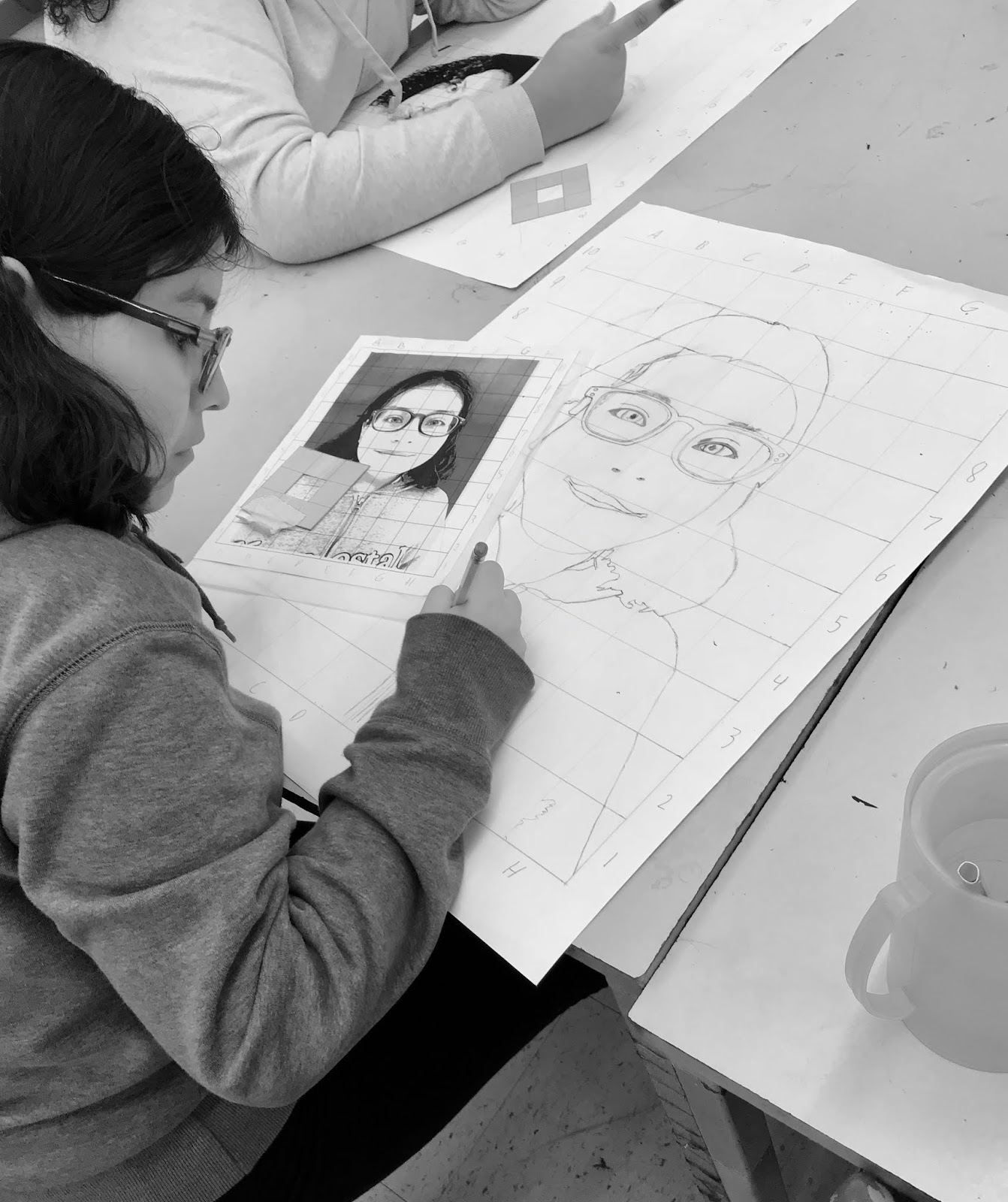
At New Roberto Clemente School (NRC) art teacher Ms Aramayo recently created an art lesson for her middle school students that integrates art with math. She used the "grid method," a method for transferring the details of a photograph or a sketch to a larger format where an enlarged artwork can then be created.
Above:  The grid technique to enlarge a sketch or photograph.
The grid technique is based on math, especially measurements and proportions.


Above:  Drawings by NRC students
The grid technique has been used throughout time. "Since Ancient Egyptian times, artists have been using the "grid method" as a drawing tool to improve accuracy. The Egyptians used this method by 'snapping' a string soaked in red dye against their drawing surface to create the lines" LINK. During the Renaissance Albrecht Durer (1471-1528) used a drawing machine to create his grids.
Above: Albrecht Durer with his time machine.
Ms Aramayo taught the students to take photographs of their faces with their cellphones first.  Next she explained to students how to place a grid on their photographs and then to make a proportional grid on a larger piece of paper.  She explained that the trick to grid art is to keep the two grids proportional.  Next students created enlarged drawings on their larger paper block by block.  Finally they used pencil and graphite to create their finished artworks.


Above:  Finished Self Portraits by NRC Students
AT Don Bosco Technical Academy (DB) art teacher Ms. Kaminski created a self portrait drawing lesson that relied on another mathematical concept: symmetry.  Her students also photographed themselves and printed out their photos.  But in Ms. Kaminski's class, they learned to cut their printed photos lengthwise in half and to glue one half of their portrait to a plain white paper, leaving room for the other half.  
Next students completed their drawings with pencils by drawing the other half of their face based on what they could see in the photographs.  They used symmetry as well as proportion and measurement in this process. Their finished drawings are equal in size to the original photo.  These artworks, now in the display case on the first floor on the first floor of Don Bosco Technical Academy attract many viewers.