Showing posts sorted by relevance for query einstein. Sort by date Show all posts

Monday, June 20, 2016

Einstein Comes Alive at NRC!

Recently a fascinating STEAM project was created at NRC/New Roberto Clemente School by art teacher Monica Aramayo.
While some NRC students were busy taking an assortment of mandated tests, Ms. Aramayo, who was teaching from an "art cart" for the duration of testing, and her art students created a startling, large-scale, collaborative work of STEAM art. She documented this process for WPU STEAM Art Professor in Residence, Triada Samaras.  
This new STEAM project now hangs near Assistant Principal Maria Francisco's office. Students engaged in creative art-making, math calculations, and science/history research to complete this innovative art project. (See image below.)
Ms. Aramayo's success demonstrates the ability of the WPU Dodge-funded NRC STEAM program to co-exist within a testing milieu, and to provide students with an educational experience, a creative challenge, and an emotional release during the stress of test-taking.

To begin this project, Ms. Aramayo taught her students the "grid method", an art-making method that allows any artist to create a large-scale work of art based on a much smaller scale image using a simple transfer method that relies on math.  Students learned this grid method is used by the well-known, contemporary American artist, Chuck Close.

Ms. Aramayo and her students found and printed an image of Einstein from the internet. Later they created a mathematical grid on top of the image, creating an 11 by 11 grid. Then, this piece of paper was cut into 121 smaller pieces, all the same size, and given to the students to work from.

On another day, Ms Aramayo and her students calculated a grid on much larger scale but proportional to the original grid. They determined the size of the squares of construction paper needed to fit each blank space of this grid. 
Above:  Ms. Monica Aramayo stands in front of the larger grid.
Next they cut blank construction paper into this same size. (See grid image above.) 
Ms Aramayo instructed students to replicate the main lines and composition of the smaller square they were given onto their new, larger blank squares, but she gave them the freedom to use any colors and patterns that they wished to complete their artwork.  The result was a total of 121 completed student squares in a wide variety of colors, patterns and textures. 

In the final installation process, Ms. Aramayo brought her art students to the site where the final piece would hang.  She instructed them to find the correct place for their square and to install it there, using a numerical system.  Students made a short, stop animation video of this exciting process. (See video below.)


The final image of Einstein at NRC is extraordinary and is inspiring teachers throughout this STEAM school to consider working in a similar way using their own content areas.  


Saturday, December 2, 2017

A Founding Father Comes Alive at a Science Fair at Don Bosco!

This fall, an arts integration project combining social studies (American history and civics) and art has led to a new large-scale art work* for Don Bosco Technical Academy (DB).  William Paterson University Art Professor-in-Residence (PIR) Triada Samaras directed this collaboration with teachers and students at this first year Geraldine R. Dodge -funded "arts integration" middle school.
This art work, created mainly in Ms. Kaminski's art class with her students, is an image of Thomas Jefferson selected by students in the next-door classroom where Ms. Simmen's social studies students are studying American history and civics elsewhere.  At the moment they are learning about the "Founding Fathers."  The art PIR demonstrated how to use the grid method to achieve the desired ends, helping these teachers envision, plan and actualize this project together, using relatively inexpensive art materials: black and white construction paper, colored pencils, and glue.  First she edited the photo. Next she cut the image into tiny squares. Then, she gave the students 9 x 9 inch square white paper and asked them to reproduce the squares. 


The art teacher worked hard over many days with mainly eighth graders to  produce the needed drawings, eighty squares in total.  She emphasized the need for the students to perceive the correct proportions and color/tonal scheme of each tiny piece of the overall image. The social studies teacher learned about the artistic grid process as it occurred by observing and conversing with the art teacher and Art PIR. For example, she learned that the living artist, Chuck Close, uses the grid extensively in his own work.


Subsequently, she decided her social studies students would create smaller "Founding Father" grid images later this month in her classroom. She will also consult with the art teacher about how to integrate a South American street artist's aesthetic into this project.
Ms. Kaminski (left) hangs the large-scale art work and Ms. Simmen (below) stands in front of the art work.
Both of these teachers are also engaging with the National History Day Theme: "Conflict and Compromise" in their classrooms. Ms. Simmen plans a National History Day project submission with social studies students.  Historically, Paterson students have performed well in this highly regarded competition.

In the coming week, a field trip will be held. Both teachers will take their students to the WPU University Galleries to see a WWI Propaganda Poster Exhibit with Director Kristen Evangelista and some of the students' parents.  After the gallery visit these students will create hands-on art works with WPU Art Professor Juan Robles.
Below, the Thomas Jefferson mural hangs with a sign detailing the process for parents on Report Card night at DB, so that other teachers in the school might learn this method as well.
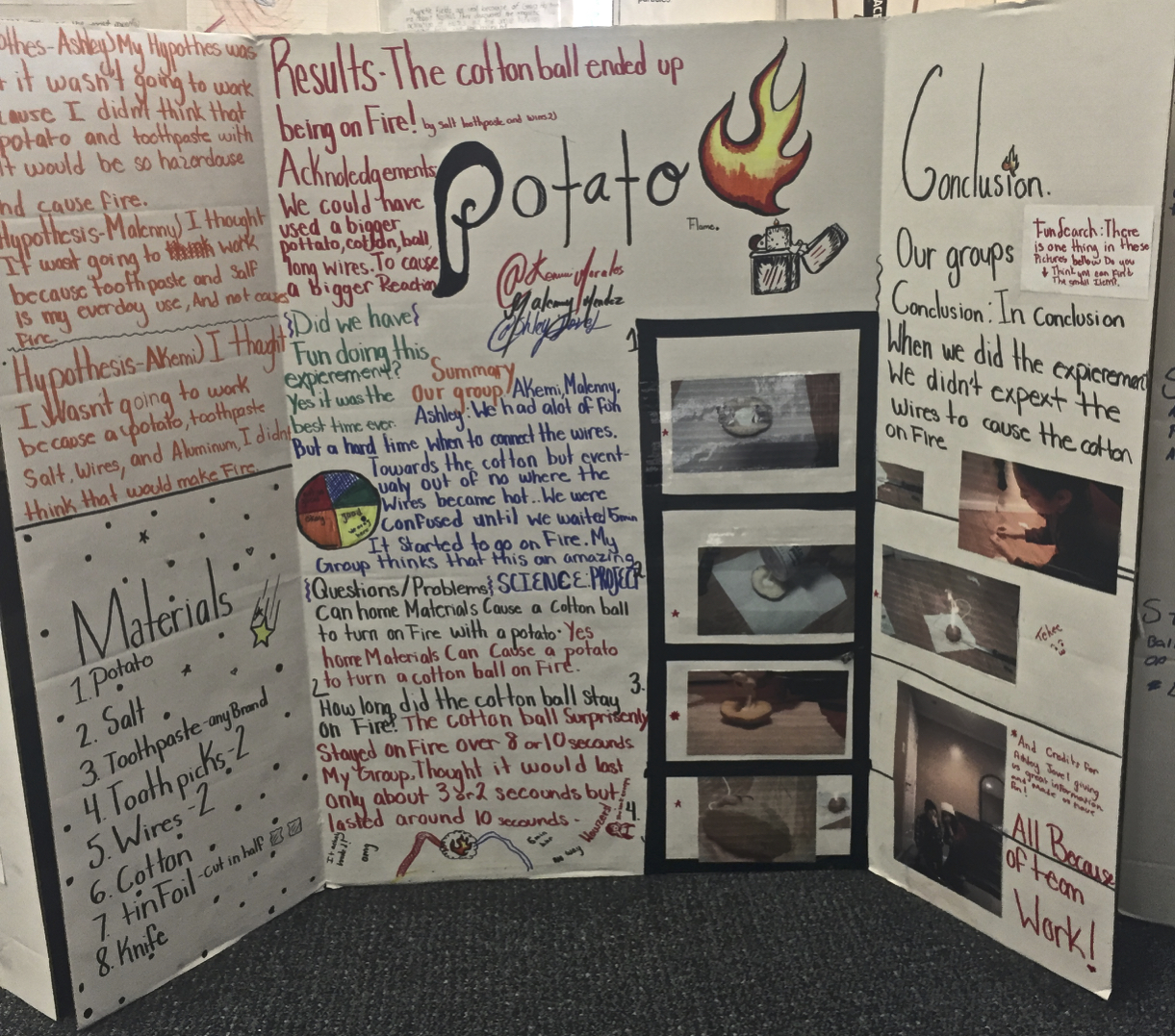
On Report Card night last week at DB, parents were invited to the media center to see the new Thomas Jefferson arts integration project together with other student art work as well as impressive student science fair projects nearby. Below are a few of these science projects:

*The large-scale grid drawing at Don Bosco of Thomas Jefferson was inspired by another large-scale art mural of Albert Einstein created by art teacher, Ms. Monica Aramayo, who works at New Roberto Clemente School/NRC.  NRC is another site where Professor Samaras is a WPU PIR funded by Dodge. This is NRC's third grant year and DB's first grant year. Thus the Art PIR plans to mirror some of the "best arts-integration practices" from NRC to DB, creating a connection between the teachers and the students at both schools. 


Wednesday, May 25, 2016

STEAM Art Projects Continue to Expand at NRC/New Roberto Clemente School

At the New Roberto Clemente School, a new collaborative STEAM art project is in the works. Led by Geraldine R. Dodge-funded STEAM Art Professor in Residence Triada Samaras, NRC teachers in all content areas are brainstorming a collaborative STEAM quilt.  This school-wide art project will be eventually hung in the student cafeteria of the NRC building.  Students who attend NRC on Saturdays will be able to gaze upon and interact with this quilt as well as students eating lunch in the cafeteria all week long.
The idea for this quilt first arose after the success of the large, collaborative paper hanging sculpture, Racimo of Reflection, specifically at the All Paterson Student Art Exhibition in March 2016.  LINK  Creating Racimo of Reflection collectively inspired teachers to brainstorm a second collaborative STEAM project and Art PIR Triada Samaras encouraged the teachers to think outside the box.
The idea for a "quilt" arose when art teacher Wendy Roche created the first “prototype” of a quilt piece, inspiring the rest of the teachers to think creatively with her.  Teachers decided that any classroom who wished could produce a quilt square with their students in the classrooms.  In addition, teachers decided that each square would communicate something about their subject using art materials.  The quilt- project would moreover be a way to de-stress the students after strenuous testing this month, e.g. the PARCC Assessment.

Technology teacher Janette Selino suggested that the quilt squares be entered into a school-wide competition for an end of year prize.  (Enrollment in this competition will be strictly voluntary.) In the past few weeks, teacher interest and participation are quickly growing. Teachers that have not yet participated in a STEAM project at NRC are now excited to join the new STEAM collaboration. More quilt news to come!
 
Above Left;
Colorful chart created by art teacher Wendy Roche to illuminate the infinite possibilities using folded paper on a quilt piece to achieve a wide variety of visual effects.
Sketch above by art teacher Wendy Roche who first envisioned the quilt to be a sort of tapestry.

In other STEAM news at NRC:
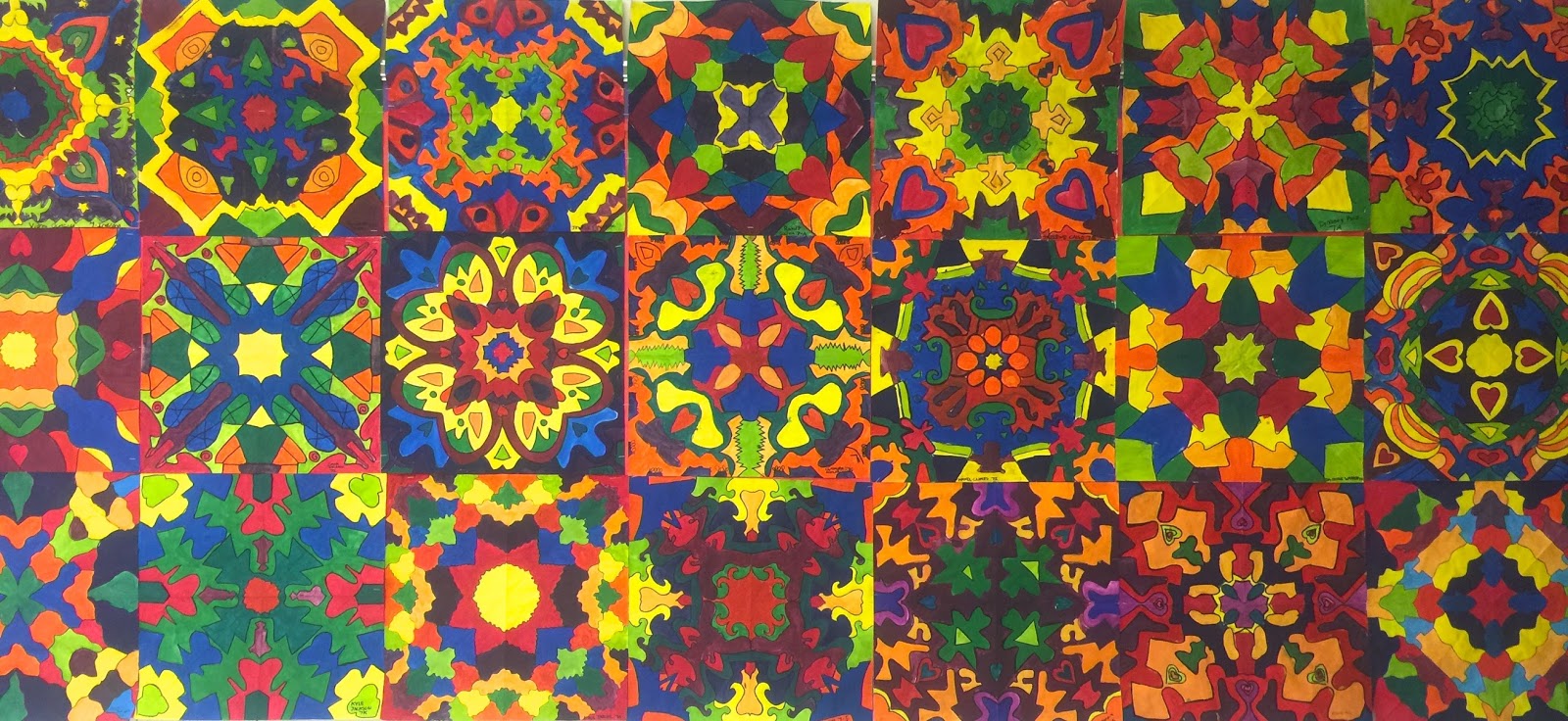
Ms. Monique Aramayo, art teacher has been doing a math/art project with her students.  Teaching them about radial symmetry and the mathematical components of a symmetrical circle pattern, Ms. Aramayo has encouraged her students to draw with pencil, then paint with tempera to create these extraordinary paintings.


Taken together as a whole these radial symmetry paintings resemble a large rug or beautiful wall hanging.
Students worked on these radial symmetry paintings with paints and papers provided by the Geraldine R. Dodge STEAM grant.


In another new technology/art STEAM project, Ms. Monique Aramayo (pictured above) demonstrates the use of technology to assess her art students using an app named Plickers. This powerful tool allows teachers to collect real-time formative assessment data without the need for student devices. Below are the materials created by Ms. Aramayo for her students to use when she is collecting data with Plickers.
In the “Basket of Math” project (see images below) , math teacher Ms. Vancheri collaborated with art teacher Ms. Roche to create this colorful and artistic basket of equations.  Ms. Vancheri had students utilize the Pythagorean Theorem to determine unknown side lengths of right triangles to solve mathematical problems.  (See rubric below.)  In addition math students wrote their equations onto colorful egg shapes.  With the help of art teacher Ms Roche, a delightful handwoven basket was created, making the math wall visually as well as mathematically inspiring.

In the lobby of NRC, 8th grade algebra teacher Ms. Natalie Diaz (pictured below) created a spectacular bulletin board celebrating Albert Einstein and National Pi Day.  Her students worked with the Sierpinski Triangle (see below) and created new formations that were placed onto this bulletin board.
 
The Sierpinski Triangle is a mathematically generated pattern that can be reproducible at any magnification or reduction. It is named after the Polish mathematician Waclaw Sierpiński but appeared as a decorative pattern many centuries prior to the work of Sierpiński. LINK
Ms Diaz also taught her students about the Menger Sponge (see above).  In mathematics, the Menger sponge (also known as the Menger universal curve) is a fractal curve. It is a three-dimensional generalization of the Sierpinski carpet, though it is slightly different from a Sierpinski Sponge.  The Menger sponge simultaneously exhibits an infinite surface area and zero volume.  LINK


In addition several fabulous STEAM bulletin boards have been recently created throughout NRC by teachers of various disciplines. Below, science and social studies teacher Ms. Munem explains how her interactive "Renewable vs. Non-Renewable Energy Sources" bulletin board combines art and science.


Another inspiring example is Ms. Flores's Spanish class which created an interactive Art/Spanish/Science bulletin board using the same art strips used for the NRC Racimo of Reflection project in a whole new way.