Thursday, December 10, 2015

STEAM Workshop Reprised

After the success of the Summer STEAM Workshop, several participants suggested a follow-up workshop to be held in the fall.  On December 3, over thirty registrants, some of whom were present in the summer and some of whom enrolled because of word of mouth about STEAM, arrived to explore the STEAM concept.

After a brief presentation by Geraldine R. Dodge Grant Coordinator Dina Scacchetti, Professor in Residence Betsy Golden introduced volunteer participants who described how they had implemented the concept of STEAM in their classes. 


May Tejada, art teacher at School 12 described how she used a lesson about radial symmetry in her art classroom that she had learned about last summer in the Summer STEAM workshop.


Thomas Fusco and John Barriento from New Roberto Clemente School described how they employed technology to teach Social Studies in grades 6 and 7.  Their students researched the architecture of ancient Egyptian culture, and built to-scale pyramids out of sugar cubes. 


Wendy Roche and Monique Aramayo, art teachers from New Roberto Clemente School explained the use of a sonobe to create a dodecahedron.  Their students then painted their dodecahedrons in colors that represent a color scale comprised of tinting and shading a single color. Thus this project combines geometry and art. 
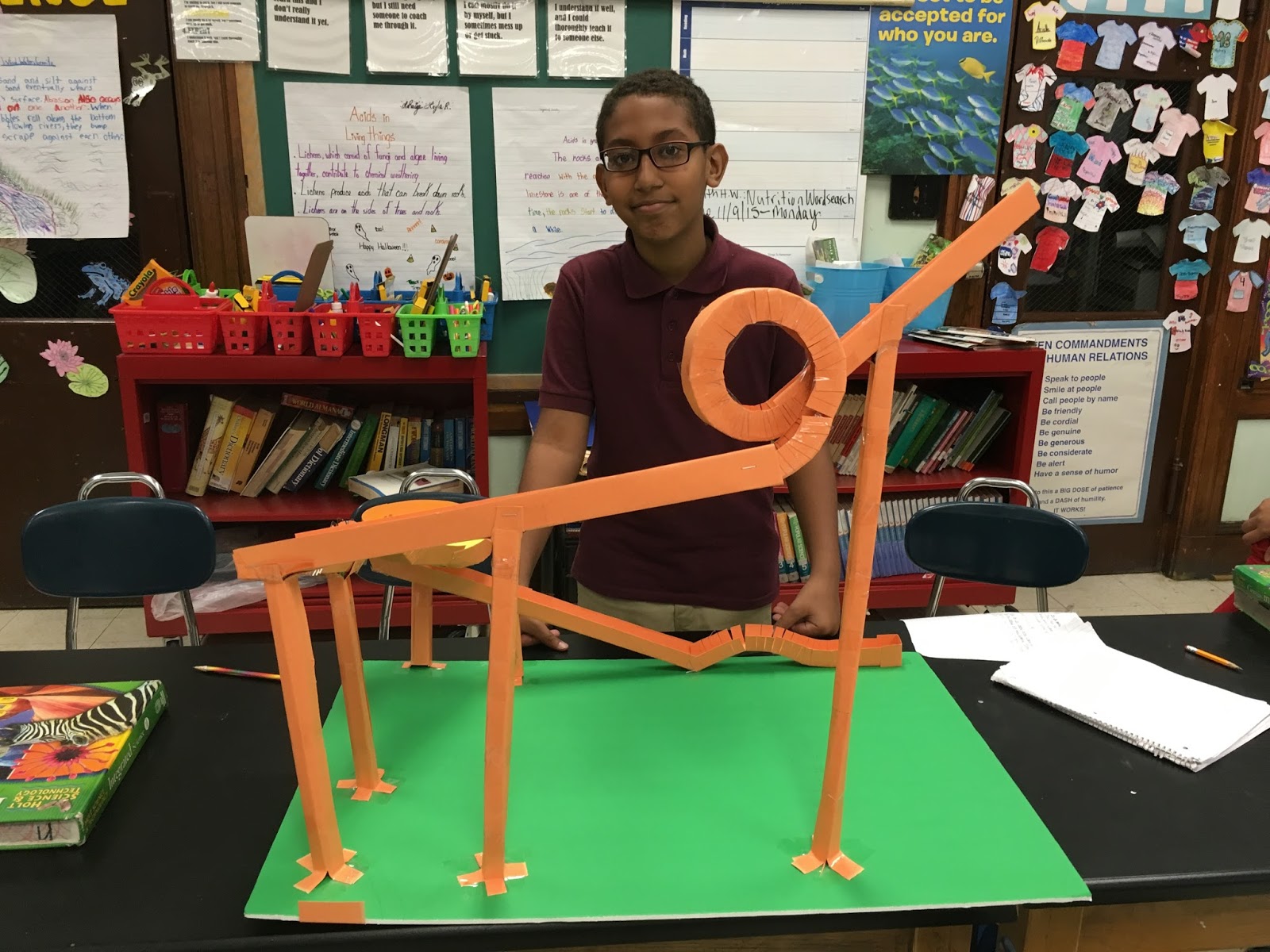


Michelle Albritton, grade 6 science teacher at School 12, after hearing Dr. Golden describe a lesson done this summer that uses common materials to teach physics, implemented the lesson in her classroom, to stunning effect, as depicted by this student project.


JeriAnn Elson, art teacher at School 29, described the many artworks that her students have created that link art with science and math.  These have been showcased on her page at the Artsonia Kids Art Museum.


Chris Fabor, art teacher at School 5 explained how he has expanded upon his work on the Biomicry lesson taught this summer. 


The workshop then allowed all participants to engage in hands-on activities, trying out several STEAM lessons.


Fish and Airplanes Help Students Learn Math and Science at School 12

 
The math concept “greater than and less than,” or “> and <” can be difficult for some students to grasp.  Under the direction of Art PIR Sandler, students in Ms. Marren’s grade 2 class each designed their own fish using Styrofoam trays (recycled from the cafeteria,) pens and crayons.  Each fish was unique, but they all had one thing in common:  gaping mouths with sharp teeth!  The fish on one side of the tray represented “greater than” while the one on the other side represented “less than.” 

Students then worked in pairs, using their fish to compare two sets of objects. 
(Special note:  alternatively this lesson can be done outside in the schoolyard with chalk on blacktop.)


How does a scientist make observations and collect data to explore scientific concepts? Mr. Anderson’s grade 5 explored this concept by determining the speed of paper airplanes.  Using thin translucent paper, students made their planes by first creating symmetrical designs using pencils, markers, and crayons, which they transferred to their airplanes.  


Working in pairs, students went into the hallway, where meter sticks had been placed on the floor to mark off distance.  They flew their planes and used stopwatches to determine the number of seconds from launch to landing, recording their findings.  By dividing the distance the planes flew by the number of seconds the flights took, the students were able to determine the speed of each plane.

Each student then had the opportunity to make a second plane, using a different folding style, to see if he or she could create a faster plane.  This part of the lesson illustrates how scientists revise, refine, and extend their knowledge, based upon observed results.

Monday, December 7, 2015

School 2 Students Explore Animal Nutrition through Clay Sculpture

In this hands-on problem solving activity, students in grades 3 and 4 special needs classes explored the meaning of the terms carnivore, herbivore, and omnivore.  Each student chose an animal from a wide selection, and created the animal with modeling clay.  


The modeling techniques of rolling, pulling, squeezing and molding encouraged hand coordination, and the resulting model provided motivation for participation.  The question was presented, “What does this animal eat?”  After determining the answer, students used toothpicks to create the types of teeth representative of their animals (e.g., sharp, tearing teeth for carnivores and flat, grinding teeth for herbivores.)

An extension of this lesson allows each student to create a habitat for his or her animal.  Using Styrofoam trays (recycled from the cafeteria lunch program) students paint a backdrop for their clay models that represents the natural environment in which the animals live.  Finally they write stories about their animals.

Eastside Students Attend a Field Trip to Ben Shahn Galleries at WPU

Students from Eastside’s School of Government, School of Information Technology, and School of Culinary Arts recently attended the exhibition “Recent Indigenous Art of India” at William Paterson University’s Ben Shahn Galleries.  Accompanied by their teachers Darryl Jones, Marilyn Simon, and Vivian Reyes, the students toured the art exhibition under the tutelage of Gallery Director Kristen Evangelista. WPU Professors in Residence Triada Samaras and Dina Scacchetti also accompanied the students.

Students began their day with a gallery tour by Director Kristen Evangelista.  They visited the exhibition: 
Many Visions, Many Versions: Art from Indigenous Communities in India
November 2 - December 11, 2015
Court, East and South Galleries
Co-curated by Aurogeeta Das and David Stanton, this exhibition features work from the Umesh and Sunanda Gaur Collection and the Ethnic Arts Foundation Collection LINK

                Above: Eastside Art teachers from left to right: Darryl Jones, Marilyn Simon, Vivian Reyes

"This exhibition features the work of various contemporary artists from four major indigenous artistic traditions in India. It endeavors to increase the appreciation and understanding of indigenous art from India, which is rarely displayed in the United States." 

"On view at the William Paterson University Galleries, this exhibition showcases four of the most prolific communities producing indigenous art in India: the Gond and Warli tribes, and the Mithila and Chitrakar communities in the states of Bihar and Bengal, respectively. The works are drawn from the Ethnic Arts Foundation Collection and BINDU modern, home of the Sunanda and Umesh Gaur Collection." LINK

Right: Gallery Director Kristen Evangelista leads an art discussion with Eastside students

Above: Geraldine R. Dodge STEAM Grant Coordinator Dina Scacchetti listens to the art talk

The exhibition was organized into four broad themes:  Myth and Cosmology, Nature—Real or Imagined, Village Life, and Contemporary Explorations.  As they viewed the artworks, the students noted the use of geometric patterns, symmetry and proportion.  Also of note was the use of pigments obtained from unexpected natural sources—such as mud and cow dung!

                     Above:  Kristen Evangelista talks about a beautiful piece of art created on a cow dung background. 

Above: Emily Johnsen, Gallery Manager, introduces the hands-on art workshop that followed the art talk in the galleries

The students then created their own artworks inspired by the themes and patterns they had seen.  Emily Johnsen, Gallery Manager, explained the task, and the students set to work.  The students created Rangoli designs, patterns and geometric shapes often made of objects from nature such as leaves, flower petals, etc.  Symmetry often governs the design

Above Left:  
                                                                          WPU Art PIR Triada Samaras works with a student painting leaves


A visit from Michelle DeMartino, Assistant Admissions Director from the WPU Admissions Office, provided them with information about college and art careers: 

Additional activities also included visits to ongoing art classes.  Students viewed a drawing class with Professor Robles, and a ceramics class with Professor Lorenz, in which the professor was instructing the students in how to integrate technology (computer graphics and 3D printing) into their projects. 

Sunday, November 1, 2015

STEAM at School 29: Engaging Teachers and Students

Teachers at School 29 recently engaged in STEAM professional development in which Art PIR Myra Winter presented a lesson on creating “foldables”.  “Foldables” are three-dimensional interactive graphic organizers that enhance student engagement and learning. 


One popular “foldable” was a student “First Aid Kit”, in which students select what significant concepts or facts are most critical, and organize them into a “kit”.  After Ms. Winters’ introduction, teachers had the opportunity to try their hands at the task.


  The room was soon buzzing with math teachers identifying ways they could utilize this tool to help students better understand key concepts, including geometry principles and vocabulary.  Language arts teachers realized that “foldables” could serve as a means for students to tells stories and share creative writing ideas. 


STEAM is also taking place in classrooms!  When second grade teacher Ms. Taliercio began to teach her students the water cycle, she realized that they could benefit from a hands-on art-related project.  She reached out to Art PIR Myra Winter, who suggested a simple collage approach. Providing the teacher with the materials as well as guidance, Ms. Winter visited the classroom and reinforced the content while modeling how the students could create their own visual representations of the water cycle.  Students were actively engaged and proud to show their creations.

Friday, October 30, 2015

Race Cars, Color Lines, and Planets at NRC


Mrs. Moose, math teacher for students grades 6-8 at NRC, recently used a lesson in her classroom from the William Paterson University Summer STEAM Workshop held in July 2015 for all Paterson Public School teachers.
This activity was very popular with teachers who attended the Summer STEAM Workshop.  Her sixth grade math students engaged in a STEAM activity, in which they built, tested, and compared their own mini-race cars.  Students measured the distance traveled by the cars on the floor as part of their math learning.


In Mrs. Moose's seventh grade class, math students created a color line and engaged in a Straight Line Board Game.


Mrs. Moose's eighth grade students created planet artworks and calculated the distance to the planets. All of these STEAM activities make math interesting and engaging for these students. STEAM activities also create collaborations in the class, teamwork, and motivation.


Above:  NRC Math Teacher Mrs. Moose with tow of her eighth grade students.


Thursday, October 29, 2015

WPU Art Practicum Student Creates STEAM Lesson at SOIT School of Information Technology

Leaves and Landscapes

Above:  WPU Practicum Student with her finished student art works

WPU Art Practicum Student Ashley Zampino, who is working with SOIT/School of Information Technology Art Teacher Marilyn Simon, recently taught an enjoyable STEAM  art lesson to high school students that focused upon several elements of art and nature. 


Students first painted a selected landscape in watercolor, using both warm and cool colors.  They created a natural and outdoor space on these papers.  Next they used actual leaf shapes to create leaf prints on tissue paper, painting the leaves with acrylic paints to mimic nature.


In addition, students painted directly onto the tissue paper aiming to produce the look of natural leaf textures. 


Finally students attached their leaf prints to their watercolor landscapes. The finished artworks allow the viewer to look into an interesting landscape painting and experience the effect of leaves falling right in front of the their eyes.